
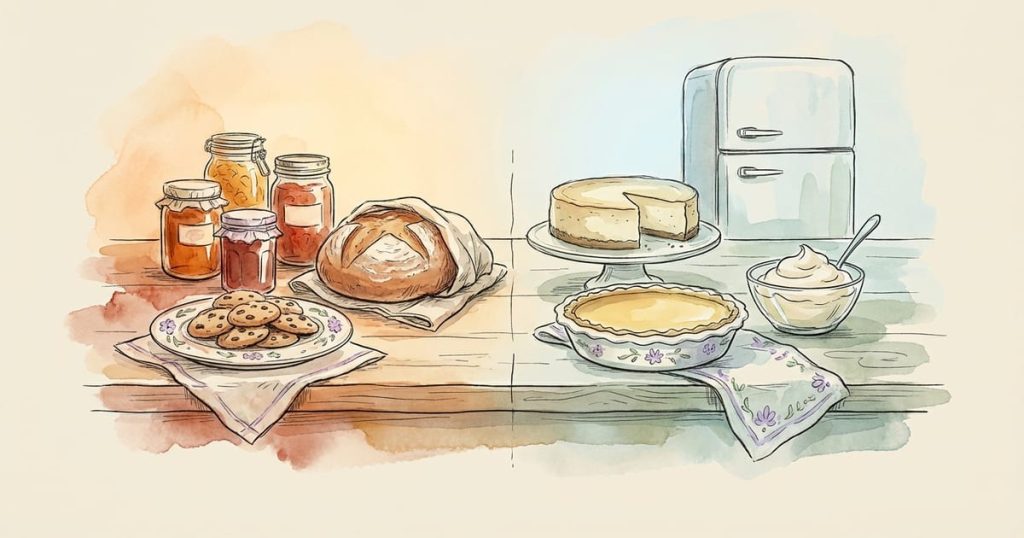
TCS stands for "time/temperature control for safety." A TCS food is one that can grow illness-causing bacteria at room temperature, so it has to be kept cold or hot to stay safe. Food scientists used to call these "potentially hazardous foods," and you will still see that older phrase in some state rules.
The line between TCS and non-TCS comes down to two numbers: water activity and pH. A food is generally treated as TCS if its water activity is above 0.85 or its pH is above 4.6. Foods below those thresholds do not support fast bacterial growth, so they can sit safely on a shelf.
This matters because almost every cottage food law is built around non-TCS foods. The shelf-stable stuff you can bake or jar at home without a licensed kitchen is, with few exceptions, exactly the food that does not need refrigeration to be safe. Understanding which side of the line your product falls on tells you whether you can sell it under cottage food law at all.
This is general educational information, not food-safety, legal, or regulatory advice. Whether a specific product counts as a TCS food, and whether you can legally sell it, depends on your recipe, your process, and your state. Confirm with your state cottage food program or a process authority before you sell.
What does TCS actually mean?
TCS describes a food that needs to be held out of the danger zone, cold or hot, to keep bacteria from multiplying to dangerous levels. If a food can sit on your counter for a day and still be safe to eat, it is non-TCS. If leaving it out would turn it into a science experiment, it is TCS.
The name changed over the years. The FDA Food Code once used "potentially hazardous food," or PHF. That term is being phased out in favor of "TCS food," but many state cottage food statutes still say "potentially hazardous." Treat the two phrases as the same thing.
The category exists because of bacteria. Pathogens like Salmonella, Listeria, and Staphylococcus aureus need moisture, low acidity, and a comfortable temperature to reproduce. Take any one of those away and their growth slows or stops. Cottage food law leans on that biology: it lets you sell the foods that are self-protecting and keeps the ones that need active temperature control inside licensed kitchens.
The plain-English science: water activity and pH
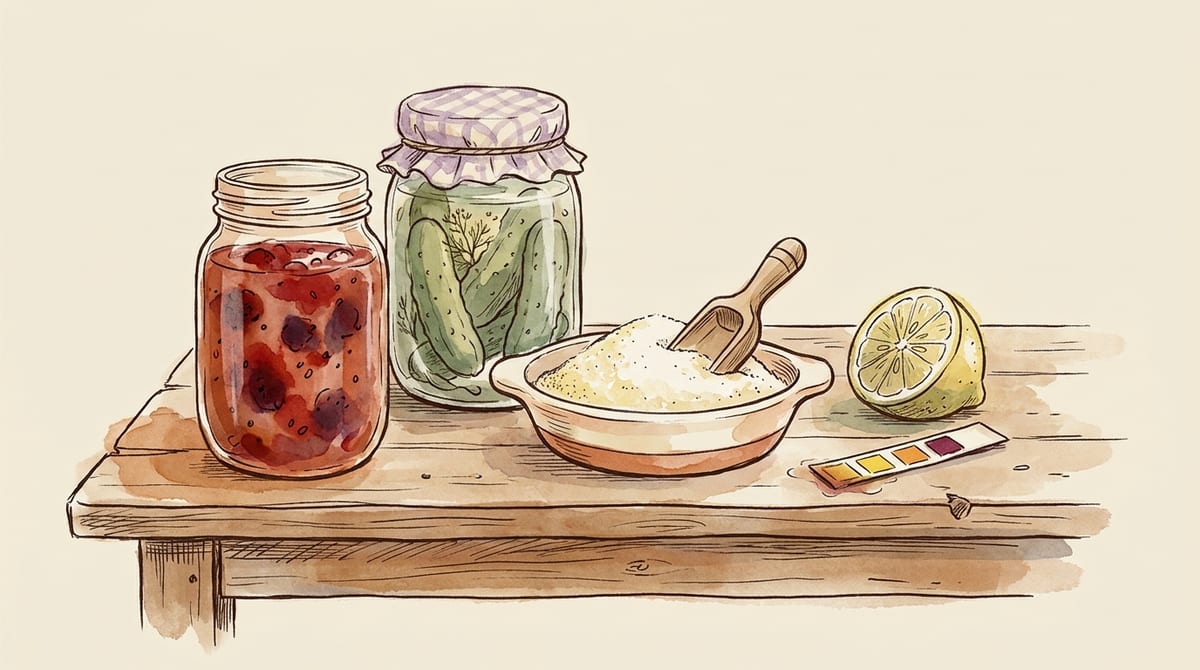
Two measurements decide whether a food is TCS. You do not need a lab to understand them, just the logic.
Water activity (aw) measures the free, unbound water in a food that bacteria can actually use. It runs on a scale from 0 to 1. Pure water is 1.0. The threshold that matters is 0.85. At or below 0.85, there is not enough available water for pathogens to grow well. This is why a dry cookie, a hard candy, or a fully dehydrated fruit is safe on a shelf: the sugar and the baking drove the water activity down. Adding a wet, fresh filling pushes it back up.
pH measures acidity on a scale from 0 to 14, where 7 is neutral and lower numbers are more acidic. The threshold is 4.6. At or below 4.6, the food is acidic enough to stop most dangerous bacteria. This is the reason a proper fruit jam, a vinegar pickle, or a lemon curd made to the right acidity can be shelf-stable, while a low-acid food like canned green beans is not. Acid does the protecting.
A food is generally considered non-TCS, and therefore safe at room temperature, when it clears both gates: water activity at or below 0.85 and pH at or below 4.6. If it fails either one, it is usually a TCS food (University of Minnesota Extension).
What is the temperature danger zone?
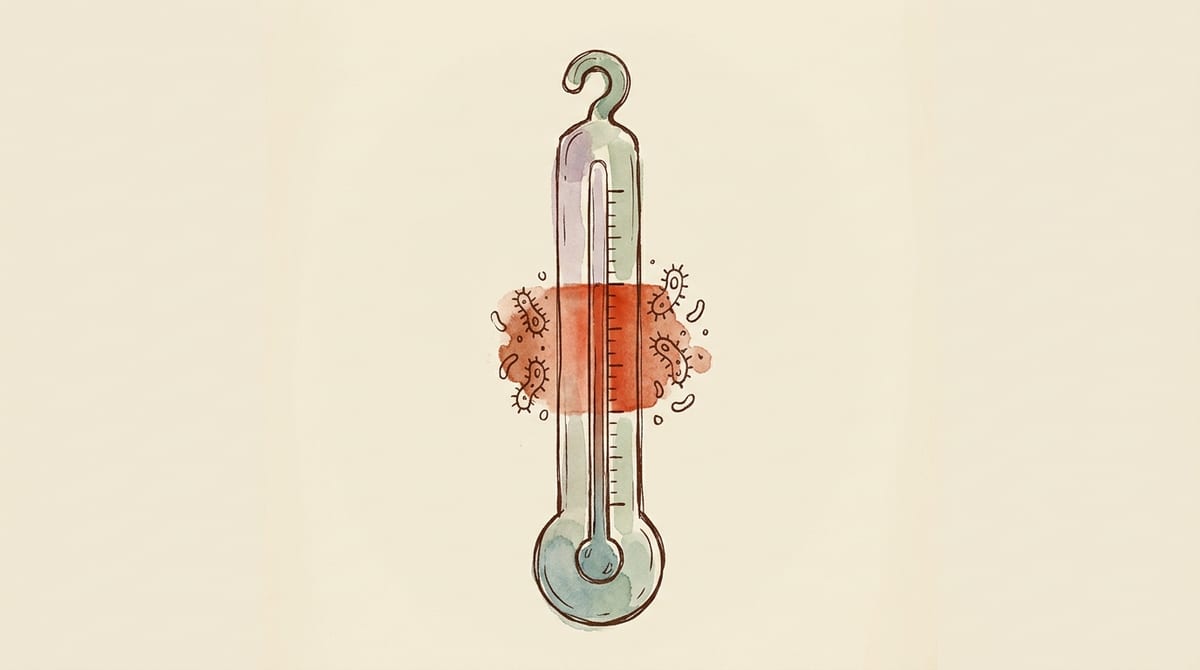
The danger zone is the temperature range where bacteria multiply fastest: 41 degrees to 135 degrees Fahrenheit (UMN Extension). Below 41, growth slows to a crawl. Above 135, heat keeps things in check. In between, and especially around body temperature, a small amount of bacteria can become a dangerous amount in a few hours.
TCS foods are the ones you have to keep out of that zone: cold-holding below 41 or hot-holding above 135. None of that is possible at a farm stand, a farmers market table, or the back of your car. That practical reality, more than anything, is why cottage food law and TCS foods do not mix.
Why is cottage food law built around non-TCS foods?
Cottage food law exists to let people sell homemade food without a commercial kitchen, a health inspection, or (in most states) a license. Regulators can only allow that safely if the foods on the list cannot easily make someone sick when they sit unrefrigerated on a table.
So nearly every state limits cottage food to non-TCS, shelf-stable products: baked goods without perishable fillings, candies, jams and jellies, dry mixes, granola, dried herbs, and honey. These clear the water-activity and pH gates on their own. The moment a product needs refrigeration to be safe, most states push it out of the cottage food category and into licensed food-processing rules.
There are exceptions, and they are growing, but the default everywhere is the same: if it needs to be kept cold, you probably cannot sell it as a cottage food. For the full picture, see what is cottage food law and what you can sell under cottage food law.
A note from April: one thing to keep in mind, especially if you follow other cottage food or farm stand vendors on social media: just because a competitor is offering an item does not mean it is actually legal to sell. If you are on this page, it is because you are worried about compliance, just like I am, so the big thing is to do your research. I have tried to do that legwork on each of our state pages, but laws change and I cannot update everything the moment they do. It is always worth reaching out to confirm what is currently allowed in your local area. The last thing you want is to get somebody sick, or to have your farm stand or cottage food operation shut down.
Start Traders Till for free.
Cost your products, print compliant labels, and track every sale. Free forever plan, no card required.
The borderline cases bakers actually ask about
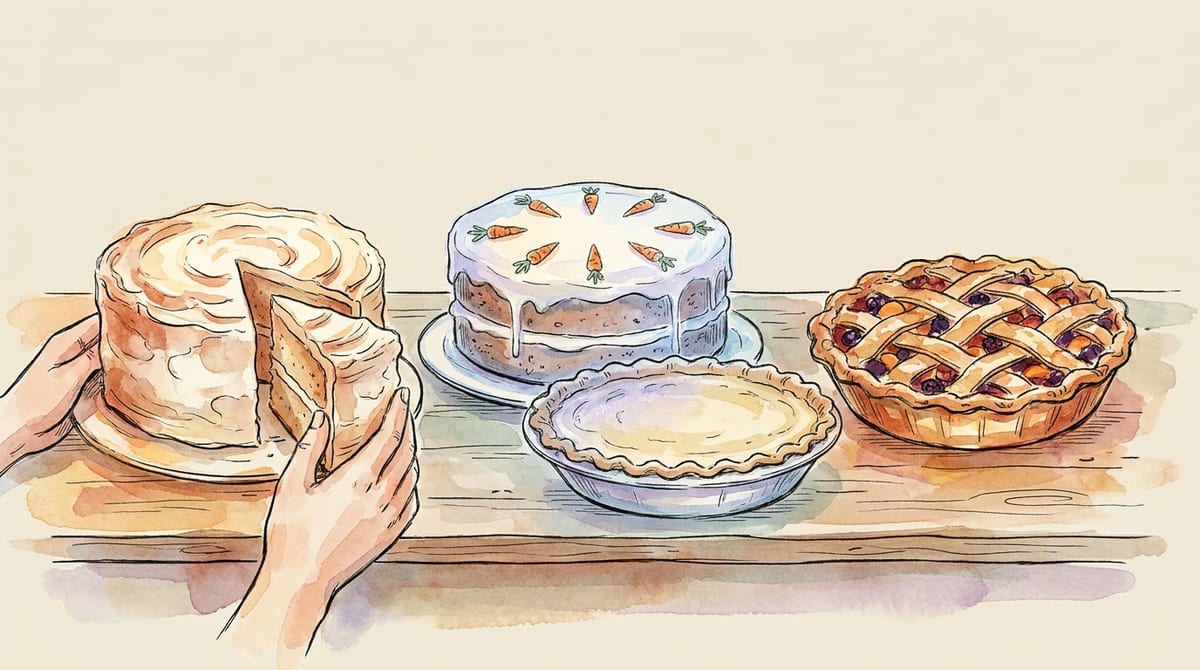
Most confusion is not about obvious foods. It is about the frostings and fillings that live right on the line. Here is where the common ones usually fall, but confirm each against your own state's list, because states draw the line in slightly different places.
| Borderline item | TCS? | Why |
|---|---|---|
| American buttercream (butter, powdered sugar, no dairy liquid) | Usually non-TCS | Sugar content drives water activity low enough that many states allow it. Some states restrict it, so check. |
| Cheesecake | TCS | Dairy-based and moist; needs refrigeration and is prohibited in most cottage food programs. |
| Cream cheese frosting | TCS | Dairy product that needs refrigeration; one of the most commonly prohibited cottage food items. |
| Custard and cream pies (banana cream, coconut cream, Boston cream) | TCS | Egg-and-dairy custard is a classic potentially hazardous food. |
| Fresh fruit fillings and toppings (cut strawberries, fresh fruit on top of a cake) | Typically TCS once cut and wet on the product | Fruit baked into a pie is a different story. |
| Fruit pies (apple, cherry, berry, cooked and shelf-stable) | Usually non-TCS | This is why cooked fruit pies are widely allowed. |
| Lemon curd and other acidic curds | Depends entirely on pH | Made to a tested pH at or below 4.6 it can be non-TCS, but this is exactly the kind of product you should not guess on. |
| Pumpkin pie | Almost always TCS | Water activity and pH both land in the risky range, one of the most frequently named prohibited items. |
| Quiche | TCS | Egg custard plus cheese, no question. |
| Whipped cream and whipped-cream frosting | TCS | Fresh dairy, needs to stay cold. |
The pattern is easy to remember: dairy, eggs as custard, and fresh cut fruit push a food into TCS. Sugar, acid, and a good bake pull it toward shelf-stable.
How do you know for sure? pH and water activity testing
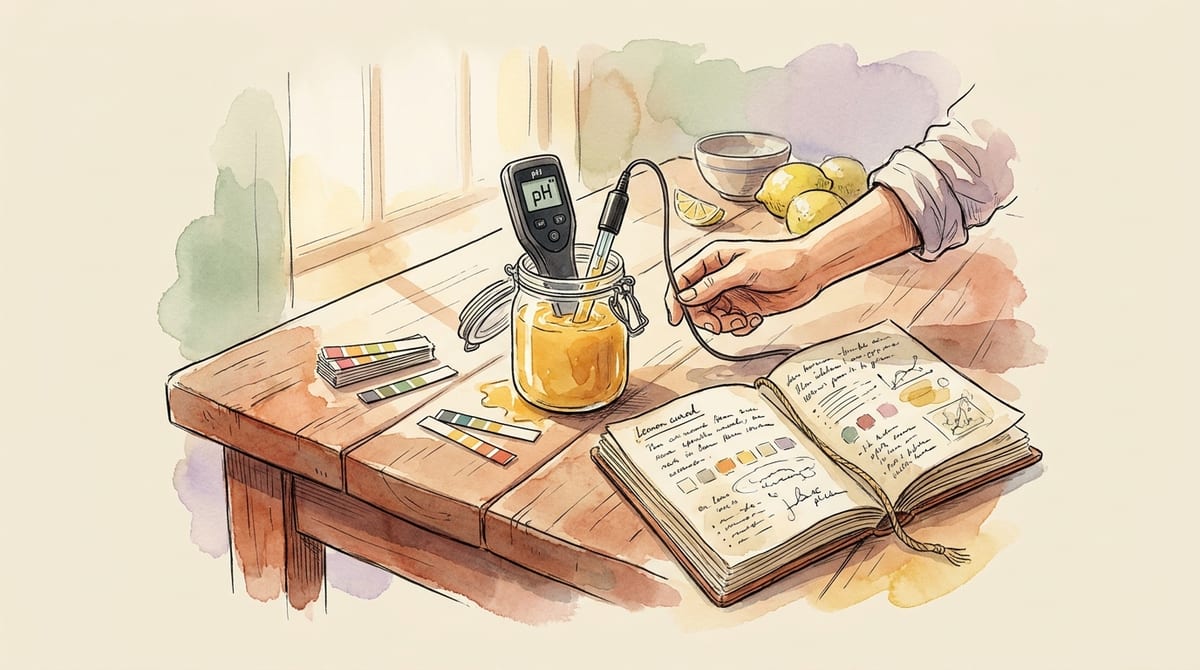
For most bakers, the allowed-foods list in your state answers the question and you never touch a meter. But for genuine edge cases, and for anything canned or acidified, guessing is not safe.
If you want to sell a product that sits near the line, you have two real options. Send it to a lab for water activity and pH testing to document which side of the thresholds it lands on. Or, for canned and acidified goods, work with a process authority, a food scientist who reviews your recipe and issues a letter certifying it is safe and correctly acidified.
Several states require exactly this documentation before they will let you sell acidified or low-acid canned foods, even under an expanded permit. Maine, for example, will not license canned or acidified cottage products until the recipe passes a University of Maine Food Testing Services process review (Maine's rules). Vermont allows home-canned pickles, vegetables, and fruits only when the product meets the pH or water-activity thresholds and the recipe comes from a tested source or has been reviewed by a food processing authority (Vermont's rules). Your state's page on the cottage food laws hub will say whether yours does the same.
This is the responsible path for pickles, salsas, hot sauces, and infused oils, which are far riskier than they look. When in doubt, treat it as TCS until a test or a process authority tells you otherwise. Our guides on shelf life of homemade products and food safety when selling from home go deeper.
Can you ever sell a TCS food as a cottage food?
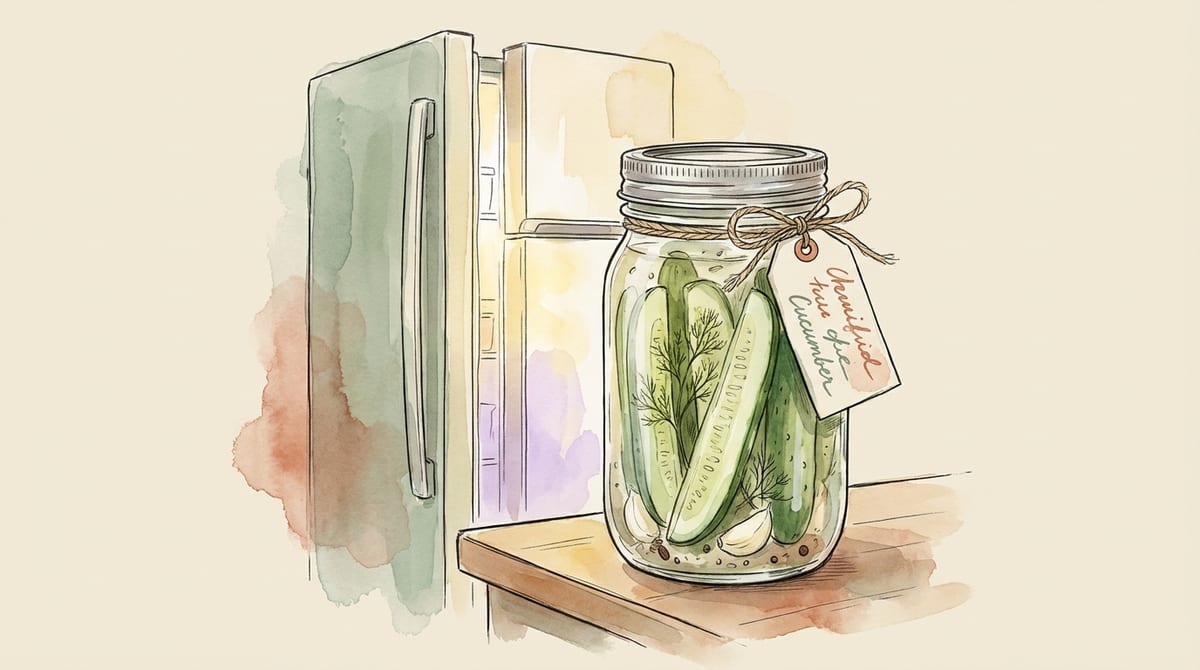
Increasingly, yes, but only through a specific permit, and never by default. A handful of states have opened narrow, well-controlled pathways for refrigerated or acidified products.
- Texas now allows some TCS (refrigerated) foods if you register with the state health department and add a date and a safe-handling statement to the label. Texas is unusually broad: it lists what you cannot sell rather than what you can. See Texas cottage food law.
- West Virginia, under SB 44 (effective mid-2026), created a potentially-hazardous cottage food vendor permit for acidified, pickled, fermented, and other TCS items, with a kitchen inspection, food-safety training, and, on a private well, water testing.
- Several other states have added or expanded TCS pathways recently, and food-freedom states tend to be the most permissive. Rules and effective dates change constantly, so confirm against your state's current program before relying on any of this.
The states that go the other way matter just as much. Connecticut specifically prohibits whipped cream, cream cheese, and buttercream frostings, and its program is one of the strictest in the country.
Massachusetts limits cottage food to non-TCS items, though it lets you use TCS ingredients like milk or eggs as long as the finished product is shelf-stable. Two states, two very different answers to the same frosting question, which is exactly why you check locally.
Compare your rules on the cottage food laws hub and see Connecticut's rules for how restrictive a state can be.
The label side of TCS
If your state does let you sell a refrigerated or date-sensitive product, the label usually changes too. TCS pathways commonly require a "keep refrigerated" or safe-handling statement and a date made, on top of the normal cottage food label.
For everything that goes on a compliant label, see cottage food labeling requirements, and for any product that has to stay cold from your kitchen to the customer, our guide to the cold chain for home food covers doing it safely.
Bottom line
TCS foods need to be kept cold or hot to stay safe, defined by two thresholds: water activity above 0.85 or pH above 4.6, with a danger zone of 41 to 135 degrees Fahrenheit. Cottage food law is built almost entirely around non-TCS, shelf-stable foods, which is why cream cheese frosting, cheesecake, custard pies, and pumpkin pie are so often off the list while buttercream and cooked fruit pies are usually fine.
A few states now offer permit pathways for TCS products, but they come with inspections, testing, and paperwork. When your product sits near the line, get it tested rather than guessing.
Knowing what you can legally sell is step one. Knowing whether it actually makes money is step two, and that is where Traders Till comes in: track every batch, sale, and cost so you can price your shelf-stable line with confidence.
Sources
Every source below was checked against the issuing agency's own page on July 13, 2026.
Summarize & Save This Guide On
Add Traders Till As A Preferred Source on Google Prompt copiedApril Lee has a B.S. in Agriculture from Cal Poly Pomona, is a certified food handler (ANAB-accredited, Learn2Serve), and holds ANAB-accredited food allergy training. She writes about selling homemade and homegrown products - cottage food rules, pricing, and the business side of farm stands - and is the co-founder of Traders Till, an app that helps home producers track what they make, sell, and earn.
Start Traders Till for free.
Cost your products, print compliant labels, and track every sale. Free forever plan, no card required.
 Save to Pinterest