
Texas
Cottage Food Laws in Texas (2026 Guide)
Last reviewed August 14, 2026
By April Lee
The short answer
In Texas, almost any homemade food is fair game: the state lists what you cannot sell rather than what you can. If it is not on that short prohibited list and needs no refrigeration, you can sell it, even shelf-stable drinks. No permit, no inspection, up to $150,000 a year. You just need a basic food-handler course and the right label.
License
Not Required
Up to $150k in sales
Training
Required
Sales Cap
$150k
Gross sales per year
Sales Tax
No
Candy is taxable
Inspection
No
Of your home kitchen
Income Tax
No
No state income tax
Summarize & Save This Guide On
Add Traders Till As A Preferred Source on Google Prompt copiedDo I need a license to sell homemade food?
No license, permit, or registration is required to sell cottage foods in Texas, as long as you stay under the $150k annual sales cap.
No permit, license, or inspection for standard (non-TCS) cottage foods. SB 541 (eff. 2025-09-01) ADDS a registration requirement for (a) operators selling TCS (refrigerated) foods to consumers and (b) cottage food VENDORS - resellers who buy from a cottage food operation at wholesale. Register free at the DSHS Online Licensing Registry (https://vo.ras.dshs.state.tx.us/datamart/mainMenu.do). Any operator may also register voluntarily to put a unique ID number on labels instead of a home address.
Do I need food-safety training?
Yes - Texas requires a food-safety (food handler) course before you sell.
Accredited basic food-safety (food handler) course required; a Food Manager Certification substitutes. ~2 hours and commonly $10–$15, typically valid 2 years, but length/price/validity are set by each accredited provider - DSHS lists accredited programs (classroom, online, private) without prices.
What foods can I sell from home?
You can sell shelf-stable foods that do not need refrigeration. Anything that must stay cold is generally off-limits.
Texas now allows essentially ANY food except the prohibited list. SB 541 even permits some TCS (time/temperature-controlled, refrigerated) foods IF the operator registers with DSHS and adds a date + safe-handling statement to the label. This is much broader than most states.
You can sell
- Breads, rolls, biscuits, cakes, pastries, cookies, pies
- Candy, chocolates, fudge (note: taxable)
- Jams, jellies, preserves, fruit butters
- Dried herbs, herb/seasoning blends, dry mixes
- Dehydrated fruits, vegetables, and herbs, whether home-dehydrated or commercially dehydrated then repackaged (allowed under Texas's inverse prohibited-list design; not named on the prohibited list)
- Freeze-dried fruits, vegetables, and snacks, shelf-stable and not requiring frozen storage (allowed under the same inverse-list reasoning; distinct from the 'Ice and frozen products' prohibition below, which targets items that must be sold or stored frozen)
- Cereals, granola, trail mix, popcorn
- Coated and uncoated nuts
- Pickles and fermented/acidic foods (batch number required on label)
- Dried pasta; vinegar
- Certain TCS (refrigerated) foods - ONLY if registered + safe-handling labeled (SB 541)
You cannot sell
- Meat, poultry, and seafood/fish/shellfish products, including jerky and other dehydrated/dried meat products (the blanket meat prohibition applies regardless of processing method, so dehydrating or freeze-drying meat does not make it sellable)
- Ice and frozen products (items that must be sold, stored, or maintained frozen); this does not reach shelf-stable freeze-dried foods, which are allowed under the inverse-list design above
- Low-acid canned goods
- Products containing CBD or THC
- Raw milk and raw-milk products
Do I have to charge sales tax?
Plain baked goods sold to-go are usually not taxable, but candy and confections are.
Bakery items (breads, cookies, cakes, pies) sold to-go without eating utensils and not heated are NOT taxable. Candy, confections, and sweetened snack items ARE taxable. Selling taxable items means you must get a Texas Sales & Use Tax Permit from the Comptroller.
How much can I sell per year?
You can earn up to $150k in gross sales per year under Texas cottage food law.
Up to $150,000 in gross annual income from cottage food sales (per household/operation), raised from $50,000 by SB 541 effective 2025-09-01. The statute has DSHS adjust the figure annually for inflation using CPI-U, so it may rise slightly each year; DSHS still lists $150,000 as of 2026-07-09 (no adjusted figure published yet).
Do I need a local business license?
State law does not add a separate local license requirement, though a general business registration may still apply.
Texas law bars cities and counties from requiring a permit, license, or inspection for a cottage food operation (preemption strengthened by SB 541). A general local business registration or assumed-name (DBA) filing may still apply separately - check your county/city.
Will my kitchen be inspected?
No - Texas does not inspect the home kitchen of a cottage food operation.
DSHS and local health departments do not inspect a cottage food operation's home kitchen.
How do I label my products?
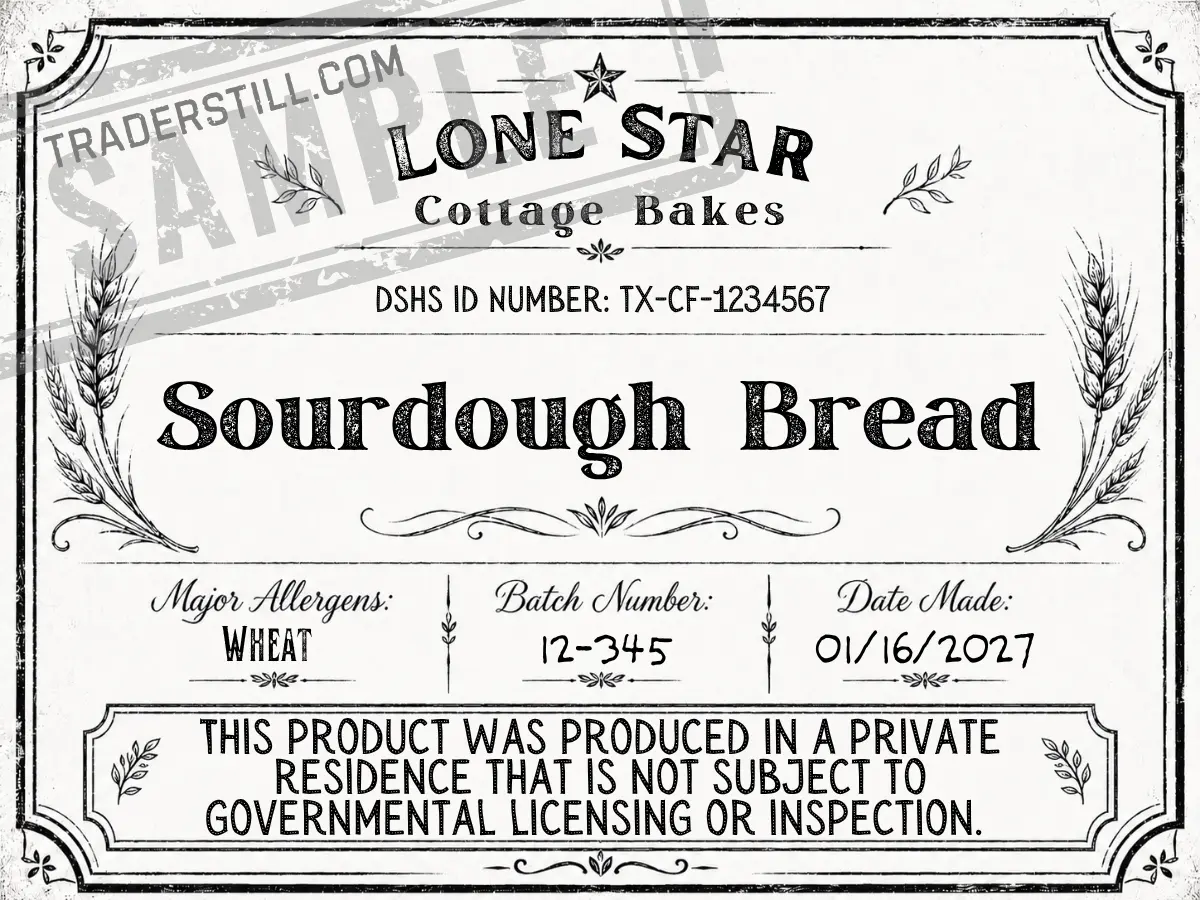
Every package must carry a specific cottage food statement, word for word, plus your standard label details.
Required on every package - exact wording
“THIS PRODUCT WAS PRODUCED IN A PRIVATE RESIDENCE THAT IS NOT SUBJECT TO GOVERNMENTAL LICENSING OR INSPECTION.”
Refrigerated (TCS) foods also need
“SAFE HANDLING INSTRUCTIONS: To prevent illness from bacteria, keep this food refrigerated or frozen until the food is prepared for consumption.”
Your label must also list
- The name of the cottage food operation
- The operation's address OR a unique DSHS identification number (address-privacy option)
- The common/usual name of the product
- Major food allergens (eggs, tree nuts, soy, peanuts, milk, wheat, sesame)
- Batch number (pickled/fermented items)
- Date made (TCS foods only)
- Safe-handling statement in 12-pt font (TCS foods only)
- The required cottage food statement (below)
Where am I allowed to sell?
You can sell directly to customers in person, and in many states online or by mail within the state.
Broad: direct to consumers (home, farmers markets, farm stands, fairs/events), online/mail/phone with delivery, AND - new under SB 541 - to food service establishments, retail stores, and wholesale to registered cottage food vendors (non-TCS items). Online and mail/phone orders are allowed, but the food must be delivered in person by the operator, an employee, or a member of the household (no third-party shipping). Texas also explicitly allows handing out samples and donating cottage foods, except temperature-controlled (TCS) items, which may not be donated. A cottage food operator may also sell wholesale to another cottage food operator. This is wider than direct-only states like Florida.
In person
Home, farmers markets, farm stands, fairs, and events.
Online
Take orders over the web, by phone, or by mail.
Shipping out of state
Do I owe income tax on what I sell?
No - Texas has no state personal income tax, so there is no state income tax on your cottage food profit.
Texas does not levy a state personal income tax, so your cottage food earnings are not taxed at the state level. You still report the income on your federal return, so keep records of sales and expenses for the IRS.
What this actually means in Texas
Texas keeps this refreshingly simple. Instead of handing you a list of what you are allowed to make, the state gives you a short list of what you cannot, and everything else is on the table, including shelf-stable drinks, which is genuinely fun to work with. One thing I would do early: register with the DSHS Cottage Food Registry so you can put your registration number on your labels instead of your home address. If you are selling at a farmers market rather than from a stand in your own yard, that little bit of privacy is worth it.
The one real hoop is a basic food-safety course, and it is nothing like the licensing a restaurant has to go through. I found a couple of accredited options online with their prices right out in the open, around $10, so this is a cheap, do-it-tonight kind of step, not a barrier.
Texas also spells out two things I love right in the law: you can hand out samples, and you can donate your food, as long as it is not a refrigerated, temperature-controlled item. Talk to your own tax lady, but donating what does not sell at your stand can do double duty, good for your community and possibly a deduction. And think past the obvious: yes, food banks and churches, but also animal-rescue groups, which can often use day-old bread or produce that did not move.
A couple of practical details people miss. You can sell online, but you, an employee, or someone in your household has to personally deliver the food to the customer, so no third-party shipping. And you are allowed to sell wholesale to another cottage food operator, which opens up nice options like sharing a booth or carrying a neighbor’s products alongside your own. As always, check the local specifics with your own agency before you lean on any of this.
Official contacts
Cottage food program
Texas DSHS - Foods Establishments / Cottage Food
State agency
Texas DSHS (cottage food is health-dept-administered in TX, not the ag dept)
Sources & citations
- .gov Texas Cottage Food Production - DSHS www.dshs.texas.gov/retail-food-establishments/permits-retail-food-establishments/texas-cottage-food-production
- Statute Tex. Health & Safety Code, Chapter 437 (Regulation of Food Service Establishments, etc.) statutes.capitol.texas.gov/Docs/HS/htm/HS.437.htm
- Statute SB 541 (89R, 2025), enrolled text - cottage food expansion capitol.texas.gov/tlodocs/89R/billtext/html/SB00541F.htm
- .gov Grocery and Convenience Stores: Taxable and Nontaxable Sales (96-280) comptroller.texas.gov/taxes/publications/96-280.php
Free PDF checklist
10 Things You Need to Do to Start a Cottage Food Business in Texas
The exact, in-order steps to get selling legally in Texas - printable and ready to check off.
You're in! Check your email to confirm, and your checklist is on the way.
Free PDF . No spam . Unsubscribe anytime