
Not always by law. If you sell as a sole proprietor under your own name, you can usually start with a separate personal account and be fine. But the moment you form an LLC or sell under a business name, a real business bank account becomes the clean, and sometimes required, choice.
Either way, keep business money separate from day one. The SBA puts the timing simply: open a business bank account "as soon as you start accepting or spending money as your business." That is a low bar on purpose, because a separate account is cheap or free and it saves you from a mess that gets more expensive to untangle the longer you wait.
Do you legally need a business bank account?
For most cottage food sellers starting out, no law forces you into a formal business account. As a sole proprietor operating under your own legal name, the business and you are the same entity for tax purposes, so a plain checking account that you use only for the business does the job to start.
Two things change that answer:
- You formed an LLC or corporation. Now the business is legally its own entity, and it needs its own account. Running LLC money through a personal account is one of the fastest ways to weaken the liability protection you set the LLC up for. If you are weighing this, see do you need an LLC for homemade food, and our LLC vs sole proprietor comparison for a home bakery.
- You sell under a business name (a DBA). If customers pay "Maple Lane Bakes" rather than your legal name, most banks will not deposit those checks into a personal account. A business account (and usually a registered DBA) is what lets you bank under the name.
So the honest framing is: a separate account is always smart, and a true business account moves from optional to expected as soon as you formalize.
It can feel like overkill when you are selling a dozen jars of jam at the Saturday market. It is not. The point is not the size of the business, it is the separation itself. If you are still setting up the basics, this is one line item on our larger checklist for starting a home food business.
What goes wrong when you mix business and personal money
One account for everything sounds simpler. Here is what it actually costs you.
- Bookkeeping becomes detective work. At tax time you are scrolling months of statements trying to remember whether a Target run was packaging or groceries. With a business-only account, every line is already a business line. Nothing to sort.
- You cannot see your real profit. When business income lands in the same account as your paycheck and your rent, "am I making money?" has no clear answer. A dedicated account shows business cash in and business cash out, so profit stops being a feeling and becomes a number.
- Tax season turns into a scramble. Your Schedule C wants clean totals for income and each expense category. Pulling those from one commingled account means re-sorting the whole year by hand. Pulling them from a business account is close to copy and paste.
- You weaken your liability shield. If you formed an LLC to protect your personal assets, mixing funds is one of the fastest ways to lose that protection. Courts call it "piercing the corporate veil," and commingling money is a classic trigger, because it shows the business was never truly separate from you. No separation, no shield.
What a business account actually gives you

Flip all of that around and the upside is concrete. Whether it is legally required or not, separating the money is the highest-leverage habit in a small food business. A dedicated account gives you:
- Clean separation. Business cash in, business cash out, nothing tangled with your rent and groceries. This is the core reason, and we go deep on it in our guide to separating your business finances.
- Easier bookkeeping. Every line on the statement is already a business line, so your bookkeeping and your year-end totals come straight off one account instead of a detective hunt through commingled spending.
- An easy Schedule C, since your income and expense totals come off one statement instead of a year of re-sorting.
- Real profit visibility, so you know what the business actually earned before you spend it.
- Professionalism. A payment in your business name reads as a real operation to wholesale buyers, market managers, and event organizers.
- Some legal protection. If you have an LLC, a separate account is the proof that the business is genuinely its own thing. The SBA puts it plainly: business banking "offers limited personal liability protection by keeping your business funds separate from your personal funds."
If cost is a concern, one of the things that you should look to see is if there is a local credit union or a smaller local bank in which you can set up your business account. Some larger banks may have minimums. I actually have two separate business bank accounts: one with Chase and one with Bank Novo however, Bank Novo wouldn't work, as far as I could tell, for a cottage food operation because there's no way to deposit cash. These are things you may not typically think about when opening a bank account, but they are a good reason why local is better.
What you need to open one
Less than most people expect. Per the SBA, banks typically ask for:
- Your EIN, or your Social Security number if you are a sole proprietor. An EIN is free from the IRS and keeps your SSN off business paperwork. We compare EIN vs SSN for cottage food in its own guide.
- Business formation documents, if you formed an LLC or corporation.
- Your DBA registration, if you sell under a business name rather than your own legal name.
- A business license, if the bank or your area asks for one. What that means locally is covered in our business license guide for cottage food.
- A government photo ID.
A sole proprietor under their own name can often open an account with just an ID and an SSN or EIN. An LLC brings its formation paperwork. Call ahead or check the bank's site so you walk in with the right documents the first time.
Start Traders Till for free.
Cost your products, print compliant labels, and track every sale. Free forever plan, no card required.
A business account, a second personal account, or a credit union?
You have a few honest paths, and any of them beats mixing money.
- A true business checking account is the real answer. It is built for this, it banks under your business name, and it plays nicely with card readers and bookkeeping tools. Watch the monthly fee and any minimum balance.
- Online business banks often win on cost. Many offer no monthly fee, no minimum balance, and quick online opening. A good fit if you rarely handle cash.
- Local banks and credit unions are worth it if you deposit market cash often, since you want a nearby branch and a relationship you can walk into. Credit unions frequently run low-fee or free small-business checking.
- A second personal account, used only for the business, is a legitimate bare-minimum start when you are tiny and testing an idea. It gives you the separation and clean records today. The catch: it is not a true business account, so plan to upgrade once sales are steady, and especially if you form an LLC.
If you are opening one either way, start it as a business account and skip the migration later.
When you compare, the SBA says to weigh introductory offers, interest rates, transaction fees, early termination fees, and minimum account balance fees. For a cottage seller, translate that to a short checklist: is there a monthly fee, is there a minimum balance, are there per-transaction or cash-deposit fees, and how easy is it to move money to your personal account. Plenty of accounts hit zero or near-zero monthly cost, so do not pay for features you will not use yet.
Keeping it strictly separate
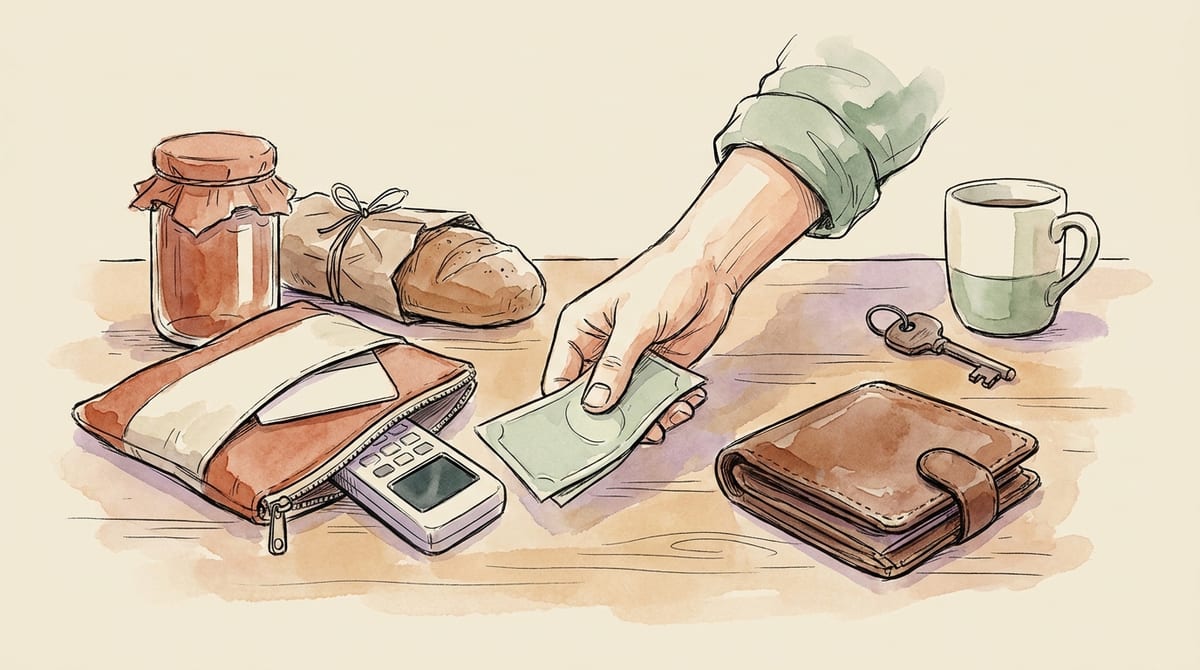
Opening the account is half the job. Using it cleanly is the other half.
- One account, one card. Get the business debit card that comes with the account and run every business purchase through it: ingredients, packaging, jars, market fees, all of it. One account, one card, and your records stay clean without any sorting. A business credit card can come later, once you want to build business credit or float ingredient costs between markets. It is not a starting requirement.
- Never dip in for personal spending. No grabbing the business card for gas because it is closer. That single habit is what keeps the records clean and the veil intact.
- Pay yourself by transfer. When you take money out, move it from the business account to your personal account as a deliberate transfer (an "owner's draw"). Do not pay personal bills straight from the business account. The transfer is your paper trail.
- Route sales into it. Point your card reader and payment app deposits at the business account so income lands where it belongs from the start.
These same habits are the backbone of bookkeeping basics for a food business; the account just makes them automatic.
Where your card reader and payment apps deposit
An account is where the money lands. You still need a way to collect it. If you take cards at the market, your payment processor deposits into a bank account you choose, so point it at your dedicated account. Square, Stripe, and PayPal all let you connect the account where your sales land.
Set the two up together and your income flows straight into clean records from the first sale. The reader and processor options, and the cash side (float, change, and what to bring), are covered in our market payments guides.
The start-simple path
You do not need the perfect banking setup to make your first sale. A sane order of operations:
- Now: open one dedicated account (a second personal account is acceptable if you are a sole proprietor testing an idea) and get its card. Route every business dollar through it.
- Soon: as sales steady, move to a true business checking account, ideally a free or low-fee one.
- When you formalize: the moment you form an LLC or start selling under a business name, open a real business account in that name and connect your card reader to it.
Keep it strictly separate the whole way: never dip into the account for personal spending, and pay yourself by deliberate transfer to your personal account rather than paying personal bills from the business.
Bottom line

You may not be legally required to open a formal business bank account to sell homemade food as a sole proprietor, but a separate account is the cheapest, highest-leverage habit you can build, and a true business account becomes the clear choice the moment you form an LLC or sell under a business name. It gives you clean books, a real read on profit, an easy tax return, and a stronger LLC, for roughly the cost of an afternoon and maybe zero dollars a month. Start with one dedicated account and card now, keep it clean, and upgrade as you grow.
If you are still building the rest of the setup, our cottage bakery setup guide and our checklist for starting a home food business put every step in order. Setting up the money side (banking, bookkeeping, taxes) is its own checklist too, and our home food business taxes and money guide puts it all in one place.
The account keeps your money separate. Traders Till keeps it organized. It is the batch-and-sales tracker that logs every sale and expense from your dedicated account, computes your real per-item cost, and has your margins and tax totals ready without a spreadsheet. Start free today.
Sources
Every source below was checked against the issuing agency's own page on September 13, 2026.
This is general information, not legal or financial advice. Account fee structures, product names, and offers change often and vary by bank; confirm current terms with the bank before you open.
Summarize & Save This Guide On
Add Traders Till As A Preferred Source on Google Prompt copiedApril Lee has a B.S. in Agriculture from Cal Poly Pomona, is a certified food handler (ANAB-accredited, Learn2Serve), and holds ANAB-accredited food allergy training. She writes about selling homemade and homegrown products - cottage food rules, pricing, and the business side of farm stands - and is the co-founder of Traders Till, an app that helps home producers track what they make, sell, and earn.
Start Traders Till for free.
Cost your products, print compliant labels, and track every sale. Free forever plan, no card required.
 Save to Pinterest