

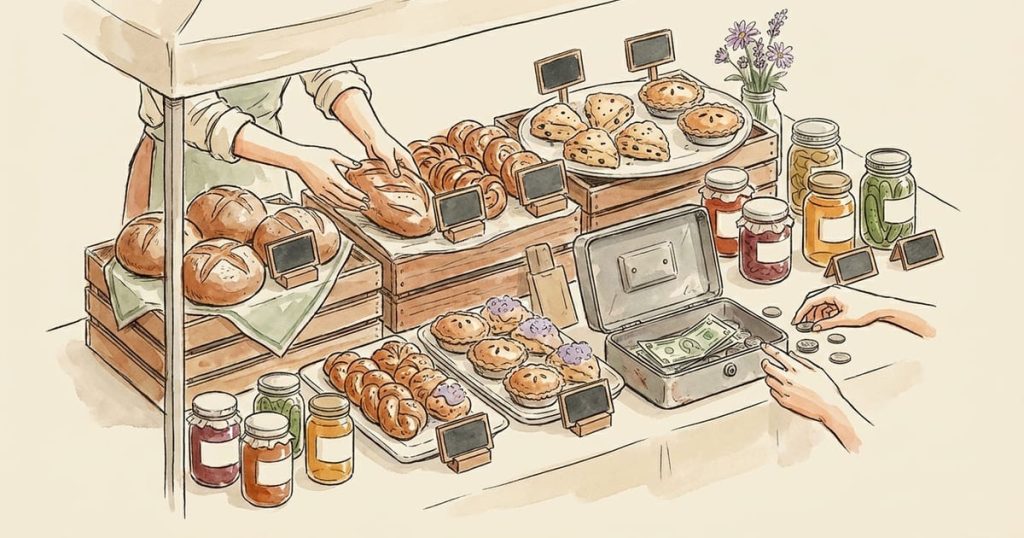
Charm pricing means ending a price in .99 or .95 ($4.99 instead of $5). It works because of the left-digit effect: shoppers read left to right, so $4.99 registers as "four something," closer to $4 than $5. That nudge is real online and on store shelves. At a cash market booth it usually backfires: round dollars make change fast, keep lines short, keep your cash box tidy, and signal handmade and confident instead of bargain-bin. Rule of thumb: charm pricing for price-sensitive items and anything sold online, round dollars for a busy cash stand and premium handmade goods.
Note: This is about how a price is written, not what the price should be. Every example below assumes you have already built an honest price from your real costs. If you have not done that yet, start with how to price homemade food, then come back to decide how to write it on the sign.
What is charm pricing, and does it actually work?
Charm pricing is the habit of ending a price just below a round number: $4.99, $9.95, $19.99. The idea rests on the left-digit effect. People read prices from the left, and the leftmost digit does most of the work. $4.99 is only a penny under $5, but the brain files it under "four dollars something," which feels meaningfully cheaper than "five." That is why almost every price in a supermarket, a big-box store, and an online checkout ends in .99.
So yes, it works, in the settings it was built for: shelves lined with competing products, and screens where a shopper is scrolling and comparing. In those places the .99 does a real job, shaving a price into a lower mental bracket right at the moment of comparison. A cash booth at a farmers market is a different animal, and that is where the advice stops fitting.
Why round numbers win at a cash booth
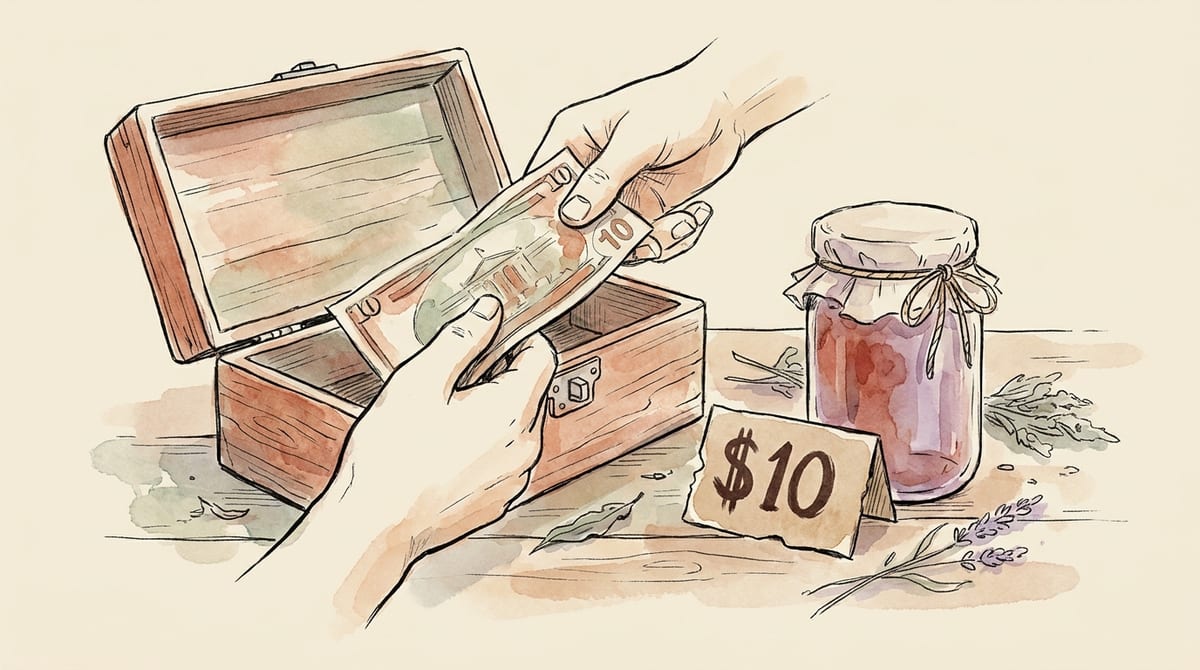
The whole charm-pricing playbook assumes a barcode scanner and a card reader do the math. At your table, you do the math, in your head, with a line forming. That changes everything.
Round dollars win at a cash stand for four practical reasons:
- Change is instant. A $10 jar paid with a $20 is a single $10 back. A $9.99 jar means counting out a penny and singles you may not have.
- You barely touch coins. Price everything in whole dollars and you can often run a booth with almost no coins in the float. Charm prices force you to keep pennies, nickels, and dimes on hand all day.
- The line stays short. Every extra second of counting change is a customer at the back deciding to leave. Whole-dollar prices keep the table moving.
- The cash box stays tidy. Round prices mean round math at the end of the day, which makes your till count and your books faster and less error-prone.
There is a signal underneath the logistics, too. A precise $4.99 reads as discount retail, the supermarket bargain shelf. A clean $5 reads as handmade and deliberate. For the shopper who walks a farmers market on purpose, that confident number is the more appealing one, not the "cheaper"-looking one. For keeping change and a float smooth all day, see the guide to handling change and payments at the market.
Where does charm pricing still win?
Round dollars are the default at the table, but charm pricing is not useless. It still earns its place in a few spots:
- Online listings. On an Etsy page or your own shop, you are back in the shelf-and-screen world charm pricing was made for, and no one is counting change. $12.99 against $13 can nudge a scrolling shopper.
- Price-sensitive, everyday items. For a low-cost staple where people genuinely compare on price, the .99 signal ("this is a value") is the right signal to send.
- A genuine markdown. End of the day, end of the season, or a blemished batch. A real "was $10, now $7.50" is exactly where a slightly-under number reads as a deal, because it is one. The key word is genuine: a fake "was" price is a trick, not a nudge, and it costs you the trust that brings people back. More on that line in the piece on psychological pricing at the market.
The pattern: charm pricing fits when the goal is to say "value" or "discount," the wrong message for a premium product at full price and the right one for a clearance jar or a budget staple.
Start Traders Till for free.
Cost your products, print compliant labels, and track every sale. Free forever plan, no card required.
Why does premium handmade read better at round numbers?
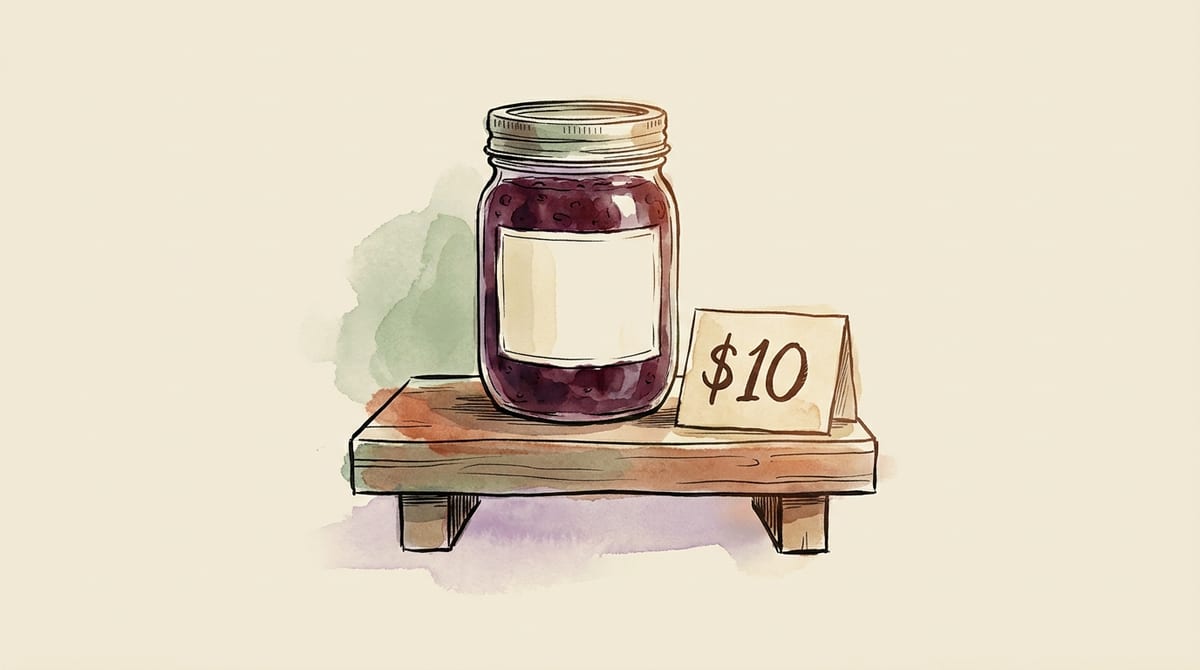
Because the number is part of the story. A $10 jar of small-batch jam competes on quality and the fact that you picked the fruit on Tuesday, not on being the cheapest jar in the room. A round price supports that.
A $9.99 quietly undercuts it, whispering "bargain" at the exact moment your label is saying "worth it." It is the same reason premium brands almost everywhere price in round numbers while discount brands chase the .99: the price is a positioning cue.
If your stand is built to read as handmade and worth a little more, a whole-dollar price is the number that matches. For how margin and positioning fit together, see pricing for profit margins.
Can I use a hybrid: round singles, charm on the deal?
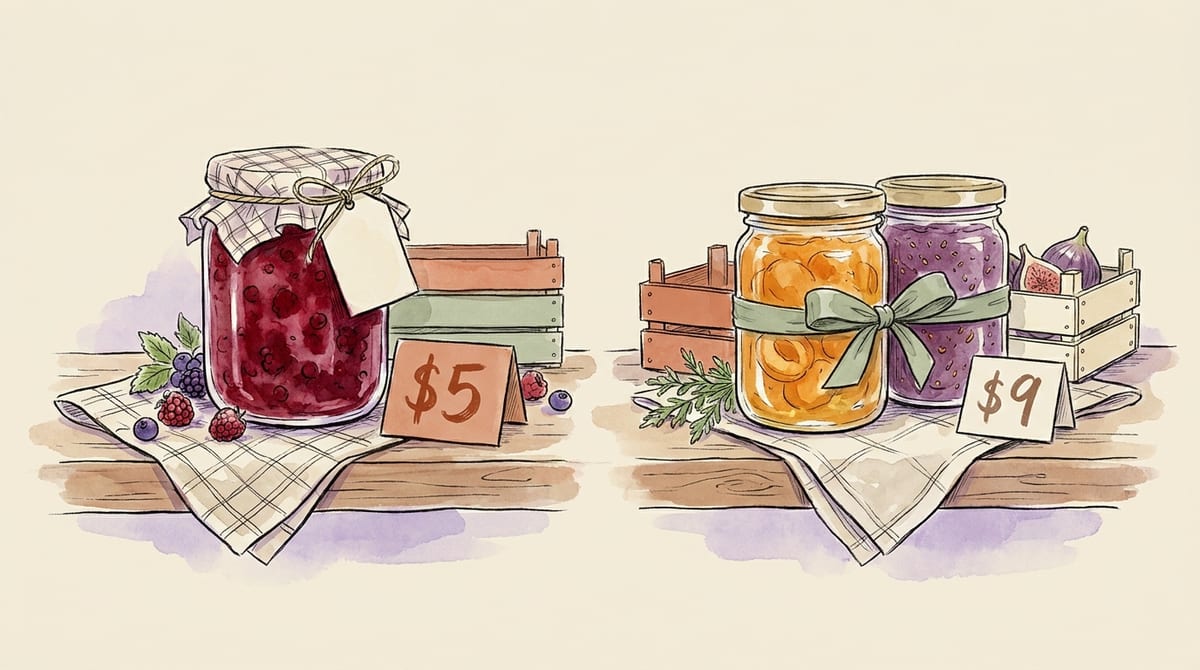
Yes, and it is often the smartest of both worlds. Keep your single-unit prices round and confident, then let the multi-buy carry the value signal.
Say you sell a small item at a clean $5 each. Price a two-pack at $9, which pencils out to $4.50 a jar. The single stays a confident round number, and the bundle does the discounting for you, so the "deal" feeling lands on the multi-buy where it belongs, not on your everyday price. The shopper sees a tidy $5 and an obvious reason to grab two.
The same trick scales up. On the $10 jam, singles stay $10 and a three-jar box goes to $27 ($9 a jar), keeping the crisp single price while rewarding the bigger basket. Two guardrails keep it honest:
- Every price, single and bundle, must clear your cost floor. On the jam that floor is $5.88 a jar, so $9 a jar in a bundle is safe and $4.50 on a $5-cost item would not be. Know your floor before you set the deal.
- The bundle must actually beat the single, or shoppers do the math and feel played.
Full setup for building multi-buys that grow the basket without eroding your margin: bundle pricing for makers.
A simple rule of thumb
When you are standing at the table with a marker and a blank price card, use this:
- Selling in person for cash? Round to the whole dollar. Fast change, short lines, tidy till, confident signal.
- Selling online or on a shelf? Charm pricing (.99 / .95) is fine, especially for price-sensitive items.
- Premium or artisan positioning? Round, everywhere. The number is part of the story.
- Running a real markdown? Charm pricing reads as the deal it is.
- Want the value signal without cheapening your everyday price? Round the single, put the deal on the bundle.
And whichever you choose, price everything clearly. A customer who has to ask usually will not, and the most confident $5 does nothing if it is not on a sign people can see: how to make price signs that sell.
Bottom line
Charm pricing is a real effect, but it was built for shelves and screens, not a cash box with a line. At a market table, round dollars beat .99 on every count that matters: faster change, shorter lines, a tidier till, and a confident, handmade signal.
Save charm pricing for online listings, price-sensitive staples, and genuine markdowns, and when you want the deal feeling without cheapening your everyday price, keep the single round and put the discount on the bundle. For the other nudges that stack on top of this, see the piece on psychological pricing at the market, and for the wider playbook, farmers market selling tips.
Whatever number you write on the card, it only works if it clears your real cost. That is what Traders Till is for: log a batch and it tracks your true per-unit cost and margin, so a round $10 or a $9-a-jar bundle always starts from what the product actually costs this week.
Start Free with Traders Till →
Want pricing tactics and new market guides in your inbox? Join the newsletter →
Summarize & Save This Guide On
Add Traders Till As A Preferred Source on Google Prompt copiedApril Lee has a B.S. in Agriculture from Cal Poly Pomona, is a certified food handler (ANAB-accredited, Learn2Serve), and holds ANAB-accredited food allergy training. She writes about selling homemade and homegrown products - cottage food rules, pricing, and the business side of farm stands - and is the co-founder of Traders Till, an app that helps home producers track what they make, sell, and earn.
Start Traders Till for free.
Cost your products, print compliant labels, and track every sale. Free forever plan, no card required.