

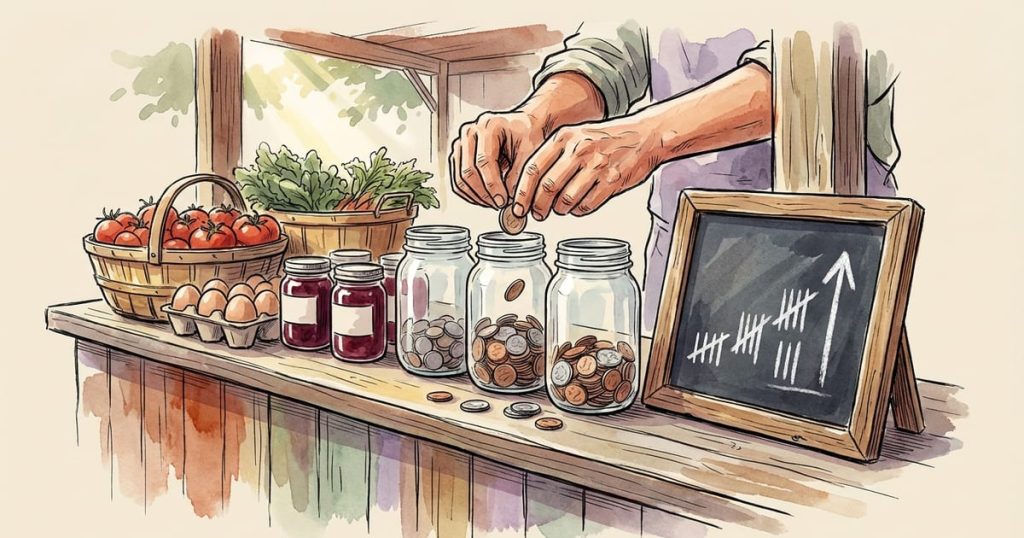
Your first four figures, around $1,000 a month or your first few thousand across a season, comes from three levers: a small repeatable product line priced for real profit, a consistent selling rhythm so customers know when to come, and tracking your numbers so you put more behind what actually sells. Set a monthly revenue target, divide it into a weekly goal, and adjust from real sales data instead of guessing.
What "four figures" actually looks like
A farm stand rarely earns the same amount every month, so do not plan around a flat number. Plan around your season. If you want $1,000 a month and you sell 16 days a month (say, four Saturdays and four Sundays, twice over), that is about $62 a day. Suddenly the goal is not abstract. It is a dozen jars of jam and two flats of eggs, or thirty baked goods at a few dollars each. Four figures is not a lucky month. It is a small daily number hit consistently.
The three levers that get you there
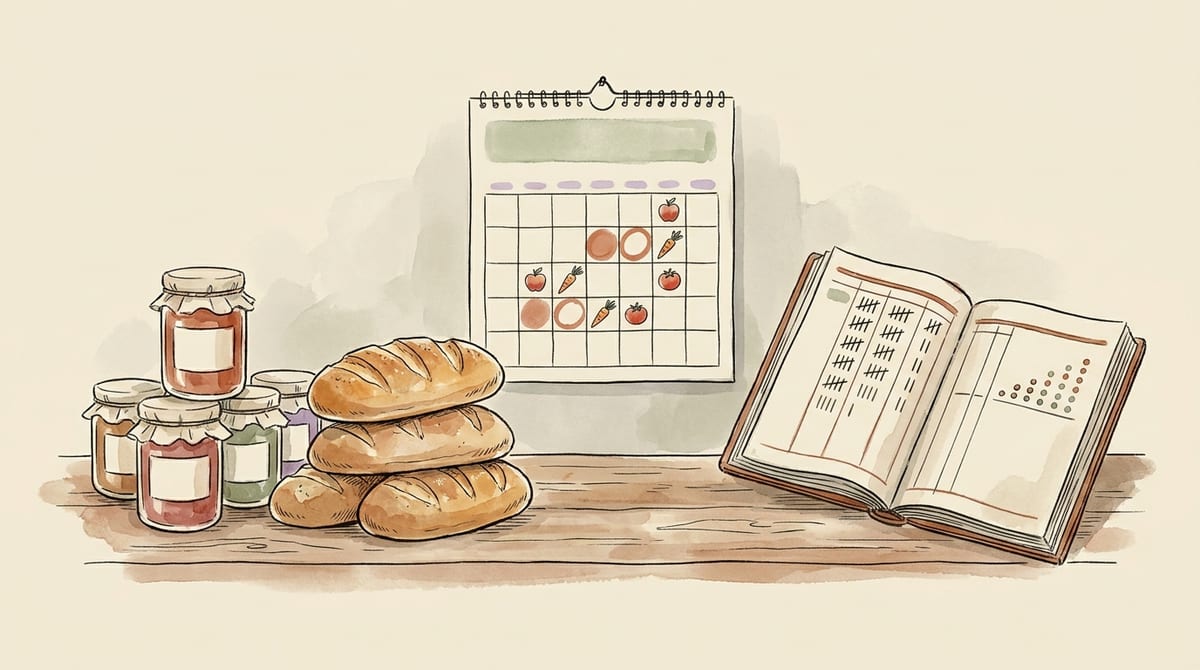
1. A repeatable product line, priced for profit
Beginners chase variety. Profitable stands repeat. Pick a short line of items you can make well and often, and price each one from your real costs (ingredients, packaging, and your time), not from what feels nice. If you have not done this yet, start with our pricing guide. A focused line you can restock without stress beats a sprawling table you cannot keep up with.
2. A consistent selling rhythm
Customers come back when they can count on you. Open on a fixed schedule, restock on the same days, and tell people when fresh product lands. Reliability is what turns a curious first-timer into a weekly regular, and regulars are the foundation of every dollar after your first hundred.
3. Track your numbers and double down
This is the lever almost everyone skips. When you record what sells, you stop guessing and start steering. You learn that your sourdough sells out by ten while the muffins linger, so next week you make more loaves and fewer muffins. That single shift, repeated, is how a stand grows. You cannot double down on your bestseller if you do not know what it is.
Start Traders Till for free.
Cost your products, print compliant labels, and track every sale. Free forever plan, no card required.
Work backward from a target

Turn the goal into a plan in four steps:
- Set a monthly revenue target. Start with $1,000.
- Divide by your selling days to get a daily goal. ($1,000 / 16 days = ~$62/day.)
- Divide the daily goal by your average sale to get the customers you need. ($62 / a $9 average sale = ~7 sales a day.)
- Stock to hit it, with a little extra on your bestseller.
Now you are not hoping for a good month. You are aiming at seven sales a day, which is a goal you can actually plan a table around.
🎁 Free printable · Traders Till
Color your way to your first $1,000 month
Pick a design, print it, and color in a piece for every sale. Five trackers that each add up to $1,000, plus a coloring page for the kids.
Five revenue trackersA coloring page for the kidsPrint-and-go, 8.5 x 11
You’re in! Check your inbox to confirm your subscription, and your free $1,000-month tracker pack is on its way.
We email you the PDF. No spam, unsubscribe anytime. Entering your email also subscribes you to the Traders Till newsletter.
Where the money quietly leaks
Three leaks keep stands stuck under four figures:
- Underpricing. Selling below your true cost means more sales just lose more money. Price first.
- Waste. Every unsold perishable is margin you already spent. Pre-orders and tighter stocking fix this.
- No record. Without a sales log, you cannot see which item carries you and which one drains you, so you keep making both.
Let your numbers do the planning
You do not have to track this on paper forever. Traders Till logs every sale and turns it into the exact numbers this plan needs: your revenue by day and week, your bestsellers, and a margin report that shows which products actually make money versus which ones just keep you busy. You set a target, and the app shows you whether you are on pace and what to make more of. Start tracking your stand free.
Hit your first $1,000 month, and the next step is repeating it and then growing past it. That is scaling to five figures.
FAQ
Frequently asked
Is a farm stand actually profitable?
It can be, but profit comes from pricing and consistency, not volume alone. A small line priced above your real costs, sold on a reliable schedule, is what turns sales into profit. Tracking your numbers is what keeps it that way.
How much can you make with a farm stand?
It varies widely by location, products, and how often you sell. A useful first milestone is four figures (around $1,000 a month), which usually breaks down to a modest daily goal hit consistently rather than one big month.
What should I sell to hit my first $1,000?
A short, repeatable line you can make well and restock easily, priced for profit. Variety feels productive but a focused bestseller-led table is what actually compounds.
How do I know if I am on track?
Set a monthly target, divide it into a daily and per-sale goal, and check your real sales against it each week. A sales log or an app like Traders Till makes this automatic.
Summarize & Save This Guide On
Add Traders Till As A Preferred Source on Google Prompt copiedApril Lee has a B.S. in Agriculture from Cal Poly Pomona, is a certified food handler (ANAB-accredited, Learn2Serve), and holds ANAB-accredited food allergy training. She writes about selling homemade and homegrown products - cottage food rules, pricing, and the business side of farm stands - and is the co-founder of Traders Till, an app that helps home producers track what they make, sell, and earn.
Start Traders Till for free.
Cost your products, print compliant labels, and track every sale. Free forever plan, no card required.
 Save to Pinterest