

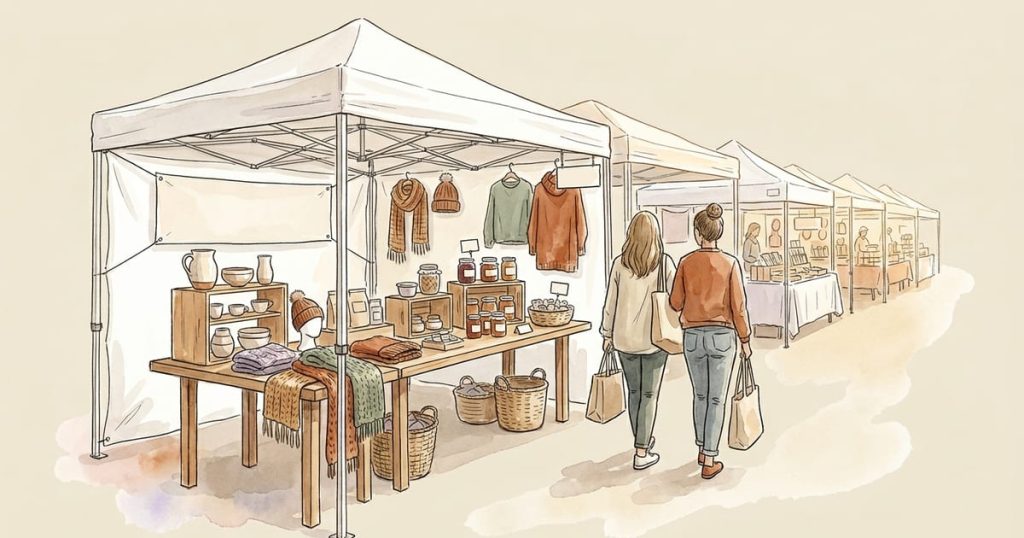
Most shoppers do not walk past your booth because your product is bad. They walk past because of something they noticed in the two seconds before they got close enough to see your product at all.
The most common reasons:
- The vendor is on their phone, or does not look up
- There are no prices, so shoppers assume they cannot afford it
- There is no easy way into the booth, or back out of it
- The booth looks like three others they already passed
- The table looks cluttered, like a garage sale
- They smell smoke or strong fragrance before they see anything
And the biggest reason of all, which you cannot fix: it is just not something they want. More on that at the end, because it matters for your sanity.
You look unavailable
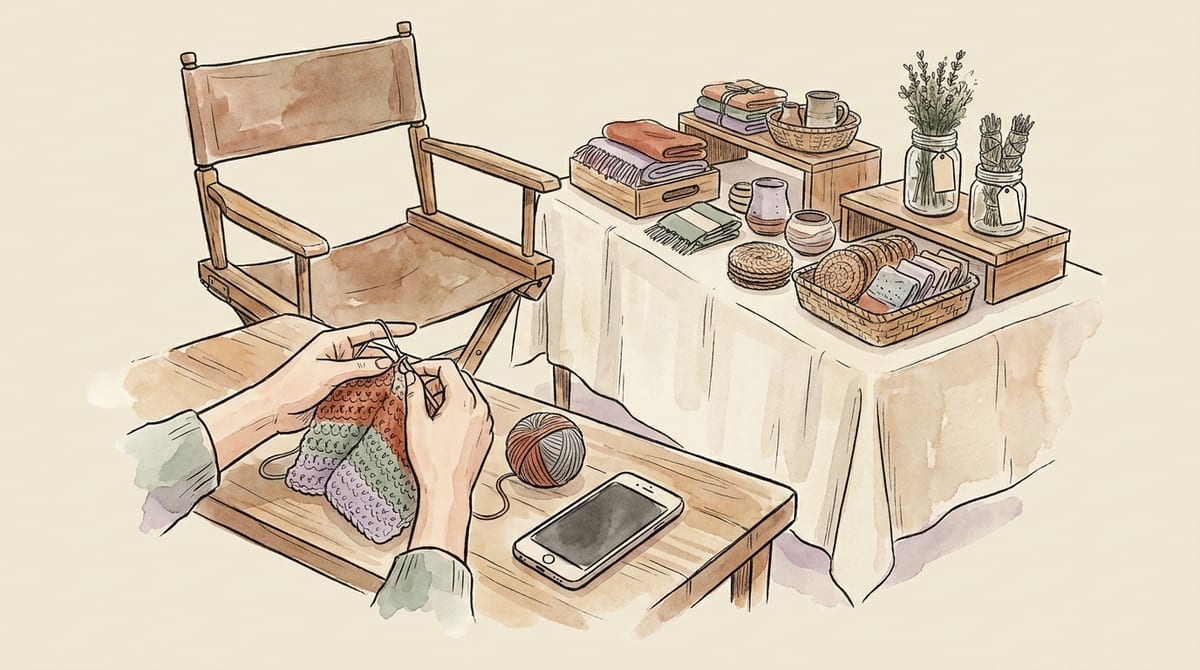
Ask market shoppers what makes them keep walking and the vendor on their phone comes up first, almost every time. So does the vendor who never makes eye contact, sits slumped low behind the table, or looks grumpy. Shoppers read all of these the same way: this person does not want to be bothered. Some will walk away mid-browse from something they fully intended to buy.
Here is the catch. The next most common complaint pulls the opposite way. Shoppers also skip booths where the vendor stares at them, hovers, calls them over from the aisle, or starts explaining every item the moment they pick one up. Most people want to be greeted and then left alone to look. If they have a question, they will ask.
So the goal is present, but not pouncing. A setup that works for both kinds of shopper:
- Sit high, not low. A tall stool or director's chair keeps you at eye level behind your table instead of sunk into a camp chair.
- Greet once, on entry. A plain "Hi, let me know if you have any questions," and then nothing.
- Keep your hands busy. Work on something between customers, so you are clearly available without staring anyone down.
That last one does double duty. When shoppers see you actually making something at your table, they know it is handmade. In a room with resold and machine-made goods, that is one of the strongest signals you can send.
What does not work: standing at the mouth of your booth like a greeter. It is well meant, but many shoppers read it as pressure and pass by. The same goes for chatting with friends who are parked in your booth entrance. Shoppers will not wait for your visitors to move.
A fair word for vendors. You are allowed to check your phone. You set up alone in the heat, hauled a canopy and a dozen totes, and you have been on your feet for hours. Checking your phone is not the problem. Looking unavailable is. Glance up and make eye contact when someone steps in, and nobody will hold the phone against you.
No prices means "I probably can't afford it"
Missing prices are one of the most common reasons shoppers give for skipping a booth, and the reason is not what most vendors think.
A lot of shoppers who walk past quickly are not uninterested. They are being considerate. They see beautiful handmade work, assume it is out of their price range, and move along so they do not waste your time or block someone who might buy. A visible price is how you tell them they guessed wrong.
Asking a price also feels like a commitment to many people. If they have to ask, plenty of them just keep walking.
Two fixes, both cheap:
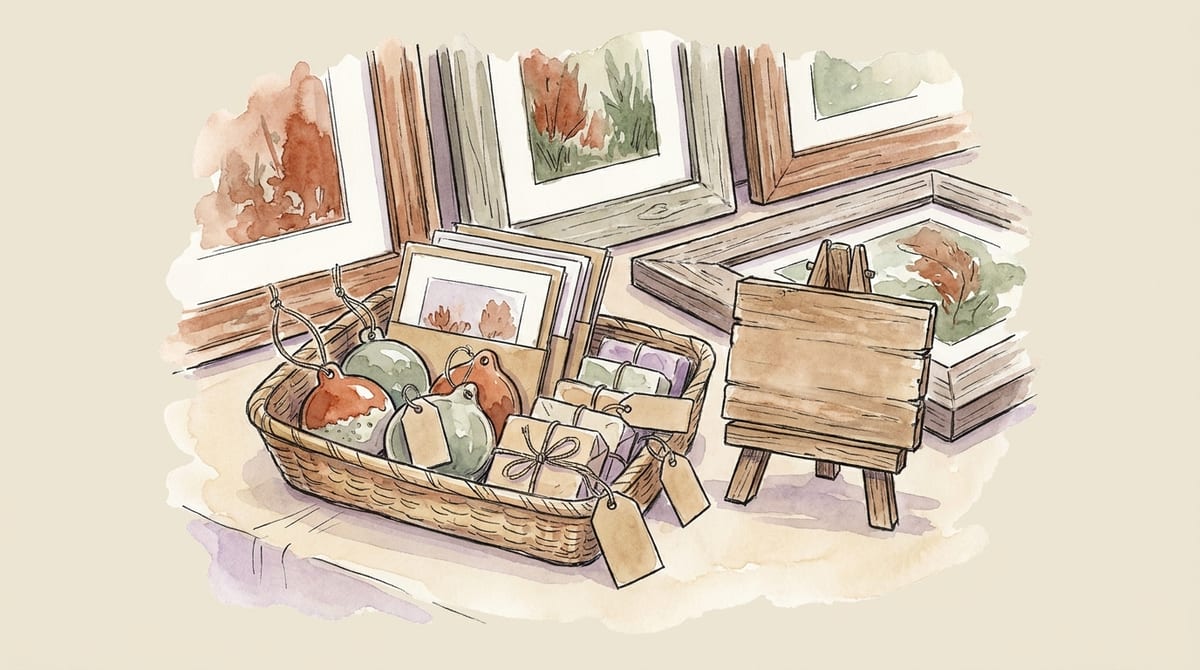
- Price everything a shopper can see from the aisle. Tags on items, or one clear sign per product group. Put signs at eye level and in the same spot on every table, so shoppers learn where to look.
- Give them a way in at a low number. If most of what you sell is a bigger purchase, add something at $10 or under: a print, an ornament, a sample size, a small version of your best seller. It turns a browser into a buyer, gives them something to gift, and some of those buyers come back for the big piece. This is the whole idea behind tiered product pricing.
If you have ever wondered whether that $10 item should be $9.99, we compared both in charm pricing vs round numbers.
They can't see a way in (or out)
Walk-in booths feel like a trap to a lot of shoppers. If they cannot see how they would get back out, or if stepping in means squeezing past you, many will not step in at all. This is why some experienced vendors keep their tables facing the aisle, and why U-shaped layouts can struggle, especially in a small space.
The things that close your booth to traffic:
- You or your chair sitting in the opening
- Friends visiting in the booth entrance
- Tables arranged so the only way out is back the way they came
- Product on the floor that people have to step around
- Displays so tight that a purse or a backpack might knock something off
That last one matters more than most vendors realize. Shoppers who are clumsy, disabled, pushing a stroller, or just nervous will skip a packed booth rather than risk breaking something.
Quick test: stand in the aisle with a big tote bag on your shoulder. Can you get to every item and turn around without touching anything? If not, open it up.
Booth layouts, from most open to most closed
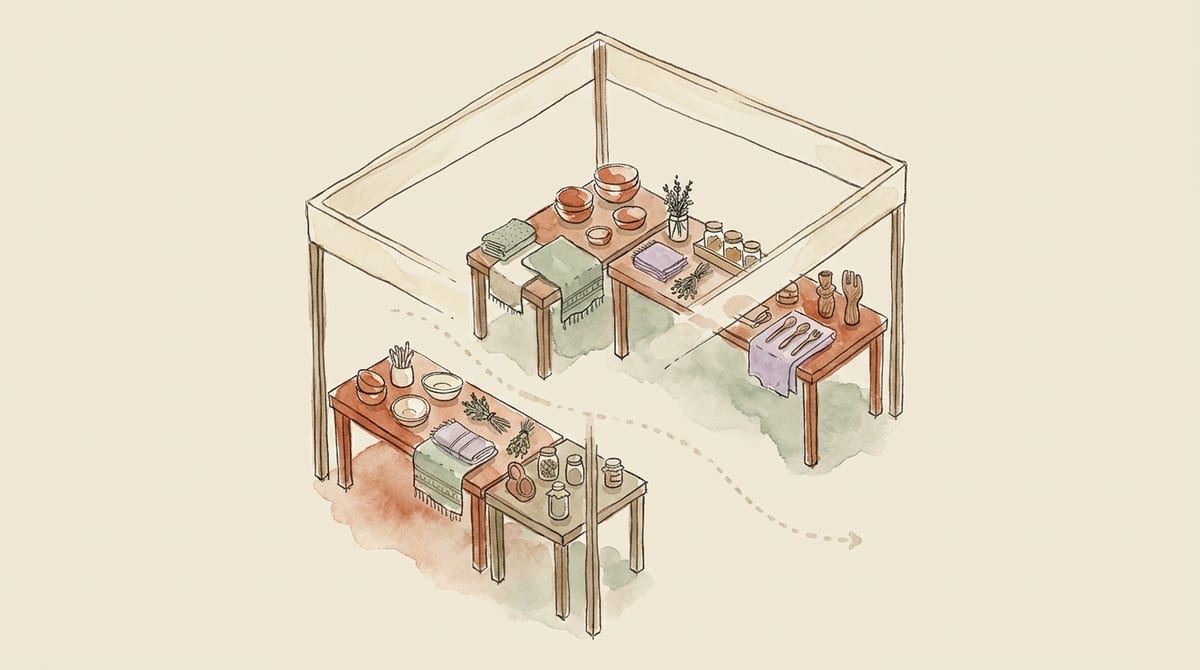
How you arrange your tables decides whether shoppers browse from the aisle or have to commit to stepping inside. The common setups:
- Straight line (front table). One table across the front, you behind it. Shoppers browse from the aisle without stepping in at all. The most welcoming layout, and the easiest to set up, but it gives you the least display space.
- L-shape. A front table plus one side table. More display room while the booth stays open on one side. A good fit for a corner spot, with the open side facing the busier aisle.
- Z-formation (staggered). Tables offset in a zigzag, so there is a clear path in on one side and out on the other. It pulls shoppers a step or two into the booth without making them feel boxed in, and it creates natural "stations" for different product groups.
- Island or center table. A table in the middle with room to walk all the way around it. Works in a deeper 10×10 when you have walls or racks on the sides. Shoppers can circle and leave from either side, so it rarely feels like a trap.
- U-shape. Tables on three sides, open to the front. The most display space, but shoppers have to walk in to see the back table, and many will not. It works best when the booth is roomy and the opening is wide, and struggles in a small or crowded space.
If shoppers keep stopping at the edge and not coming in, try moving one table. Going from a U to an L or a Z is often the fastest fix, because it opens a way out that shoppers can see from the aisle.
It looks like every other booth
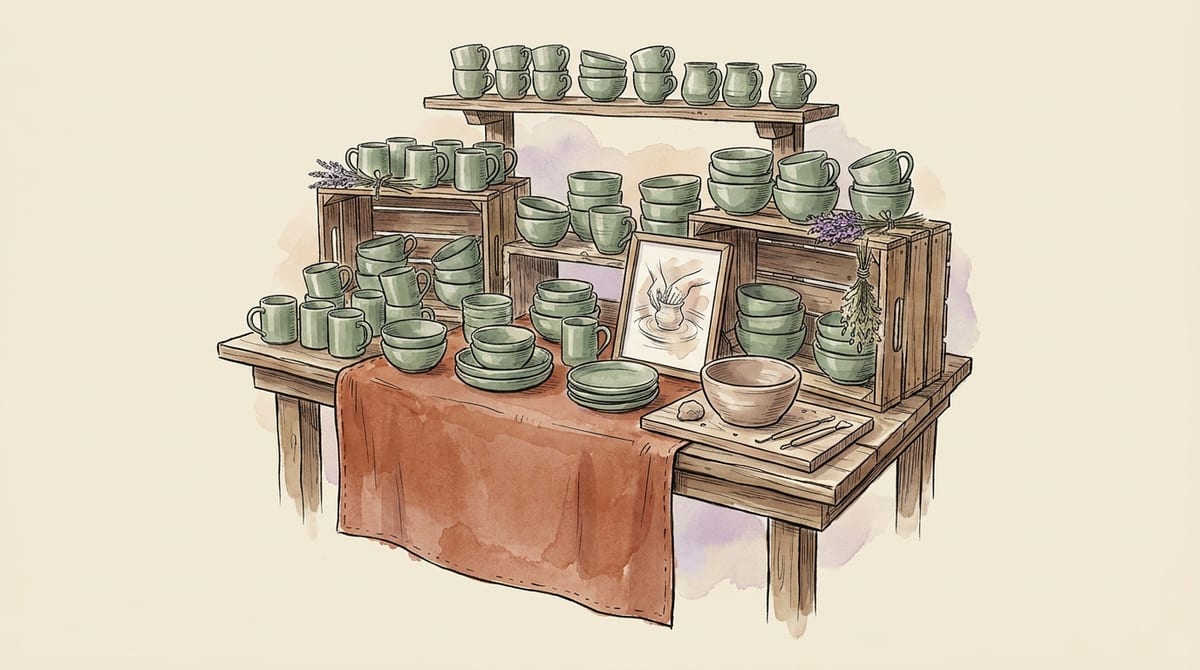
Shoppers who go to a lot of markets get tired of seeing the same things. The categories they name most often as "seen it everywhere":
- Tumblers
- 3D printed items, especially dragons and other articulated critters
- Crocheted animals and dish towels
- Jewelry, especially earrings
- Laser-cut wood and vinyl-lettered signs
- Mass-produced "boutique" clothing
If that list includes what you make, do not panic. These categories are crowded because they sell. But it does mean your booth has to answer a question every shopper is silently asking: what are you offering that the last five booths were not?
What makes shoppers stop:
- A clear point of view. A booth that does one medium or one theme well draws people in. A booth that looks like a small department store gets skipped.
- Visible branding. A name, consistent labels, and matching signage tell shoppers you take your work seriously.
- Something regional, funny, or unexpected. Whimsical, local, repurposed, or just plain odd items get people to slow down. A sign that makes someone laugh works too.
- Proof it is really handmade. Shoppers are increasingly wary of AI-generated designs, licensed characters, and resale items passed off as handmade, and some will not stop once they spot one. If you make it, show it. Put up a process photo, keep a work in progress on the table, or add a small sign that says what you do by hand.
Some of this is on the event, too. When you are choosing which shows to apply to, it is fair to ask the organizer how many vendors in your category they accept.
Start Traders Till for free.
Cost your products, print compliant labels, and track every sale. Free forever plan, no card required.
The table looks like a garage sale
There is a real tension here, because a full table sells better than a sparse one. But there is a fine line between well stocked and cluttered, and once you cross it, shoppers stop seeing products and start seeing a pile.
The fixes:
- Height. Items displayed flat on a table get skipped. Use risers, crates, or shelves.
- Small things at eye level. Nobody wants to bend over to look at tiny earrings.
- Tablecloths to the floor. Hide the bins, the boxes, and the cooler.
- Nothing to dig through. If it is in a bin, it is inventory, not display.
- Keep it bright. Dark side walls make it hard to see inside. Bright colored canopies (red, purple, blue) also tint everything under them and can make products look off-color. A white or neutral canopy is the safe choice.
Something they notice before your product
A few turnoffs hit before a shopper even reaches your table. They are instant deal-breakers for the people who notice them:
- Smoking in or near the booth. Shoppers can smell it from the aisle, and it clings to products.
- Strong fragrance. Heavy candle, incense, or perfume scent sends shoppers with migraines and allergies away fast, sometimes from a whole row.
- Pets in the booth, for shoppers with allergies.
- Political signs or merch, from any side. Many shoppers skip these regardless of whose politics they are.
- Signs that scold. "Smile, you're on camera" and "Card Only" can read as unwelcoming. If you need to say it, say it kindly, or say what you do accept.
None of these are about your product. All of them are fixable before the market opens.
The reason you can't fix (and shouldn't try to)
The biggest reason shoppers walk past is also the simplest: they do not want or need what you sell. That is it.
Some shoppers are makers themselves and skip anything they could make at home. Some only buy food. Some only buy antiques. Some cannot eat sugar and skip every bake stall. Some already own five tumblers. None of that is about you.
If you tried to please every shopper who walks by, you would never set up at all, because their preferences are all over the map. That is not the point. The point is to stop losing the shoppers who would have wanted your product and were turned away by something that had nothing to do with it.
A 60-second check from the aisle
Before the market opens, walk ten steps out into the aisle, turn around, and look at your booth the way a stranger will:
- Can I see a price on every product group from here?
- Is there something for $10 or under?
- Is the entrance clear, including of me and my chair?
- Could someone with a big bag turn around inside without touching anything?
- Can I tell what makes this booth different in one glance?
- Is anything on the floor, in a bin, or flat on the table that should be up high?
- Is my phone out of my hand for the first few seconds when someone walks up?
- Does it smell like anything besides my product?
Bottom line
Most of what makes shoppers keep walking is not your product. It is prices they cannot see, an entrance they cannot get through, a vendor who looks either absent or too eager, and a table that looks like the last three they passed.
The fixes are small and cost almost nothing. The hard part is knowing which one moved your sales. Change one thing per market, then compare what you sold. That is the job Traders Till was built for: log what you sell at every market, so you can see whether the new price signs or the reworked table actually paid off, instead of guessing.
Start free with Traders Till →
Want more market-day tips in your inbox? Join the newsletter →
If your prices are what keep people walking, start with the pricing mistakes that catch home makers, and use the maker hourly rate calculator to make sure your low entry item still pays you.
FAQ
Frequently asked
Why do people walk past my booth without looking?
The most common reasons are a vendor who looks unavailable (on their phone or not looking up), no visible prices, a booth that is hard to walk into, and products that look like other booths at the same show. Often the product is simply not something that shopper wants, and that is not something to fix.
Should I sit or stand at my craft booth?
Shoppers dislike both extremes: vendors slumped in a low chair on their phone, and vendors standing in the booth entrance watching them. A middle path works for most people. Sit on a tall chair at eye level behind your table, greet people once when they step in, and keep your hands busy with your craft.
Do I really need price tags at a craft show?
Yes. Missing prices are one of the most common reasons shoppers skip a booth. Many shoppers who walk past assume they cannot afford handmade work and do not want to ask. A visible price, plus at least one low-priced item, tells them it is worth stopping.
What products are oversaturated at craft shows?
Shoppers most often name tumblers, 3D printed figures, crocheted animals and dish towels, jewelry, laser-cut and vinyl-lettered wood signs, and mass-produced boutique clothing. You can still sell well in these categories, but your booth needs a clear reason to choose you, like a distinct style, visible branding, or proof it is made by hand.
How do I get people to walk into my booth?
Keep the entrance completely clear, including of yourself, your chair, and visiting friends. Walk-in booths can make shoppers feel trapped, so many vendors keep their tables facing the aisle, and make sure there is room to turn around without bumping anything.
Summarize & Save This Guide On
Add Traders Till As A Preferred Source on Google Prompt copiedApril Lee has a B.S. in Agriculture from Cal Poly Pomona, is a certified food handler (ANAB-accredited, Learn2Serve), and holds ANAB-accredited food allergy training. She writes about selling homemade and homegrown products - cottage food rules, pricing, and the business side of farm stands - and is the co-founder of Traders Till, an app that helps home producers track what they make, sell, and earn.
Start Traders Till for free.
Cost your products, print compliant labels, and track every sale. Free forever plan, no card required.
 Save to Pinterest