

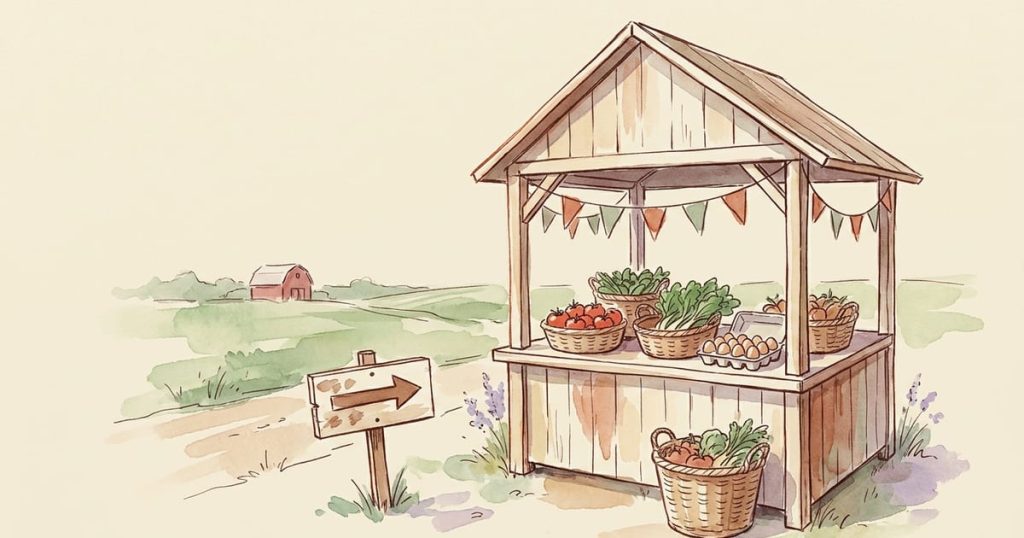
At most farm stands, your sign is not decoration. It is your entire storefront. The majority of your customers are people driving past who did not plan to stop, and they will decide whether to pull in within a few seconds, based almost entirely on what your sign tells them.
So a good farm stand sign does three jobs, fast: it says what you are (a farm stand), it says what you are selling right now (eggs, sweet corn, flowers), and it says you are open. Big letters, few words, one clear idea, and an arrow if they need to turn.
Get that right and a plain roadside stand starts pulling in strangers, not just the neighbors who already know you are there.
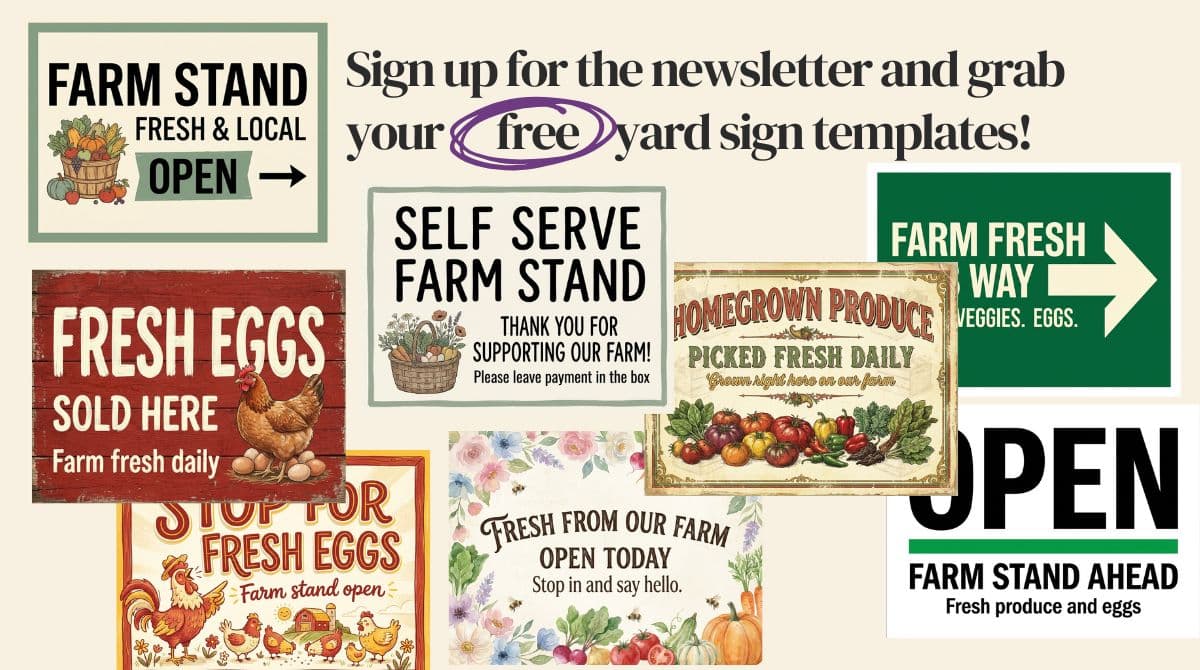
To make it easy, we made you a free pack: ten printable farm stand yard-sign templates, sized for standard 24 by 18 inch signs, in a range of styles from clean and modern to hand-painted and rustic. Grab it at the bottom of this page and skip the design work entirely.
This post contains affiliate links, which means I may receive commissions if you choose to purchase through links I provide (at no extra cost to you). As an Amazon Associate I earn from qualifying purchases.
Quick note: Sign placement rules vary a lot from one town to the next, so treat the "where can I put it" section as a starting point, not legal advice. Before you stake anything near a road, check with your local zoning office and state DOT. A quick phone call is cheaper than a fine or a removed sign.
Your sign is doing more work than you think
Picture how a sale actually starts at a roadside stand. Someone is driving to soccer practice or home from the store. They are not looking for eggs. Then they see your sign, and in the space of a breath they decide: interesting, or not.
That is the whole funnel, and it happens at 35 miles an hour. Everything else about your stand, the beautiful produce, the fair prices, the honor-system box, only matters if the sign does its job first and gets the car to slow down.
This is why signage is the highest-leverage cheap thing you can fix at a stand. A nicer table will not double your traffic. A sign that suddenly reads clearly from the road can. University extension programs treat roadside signs as a core marketing tool for farm stands for exactly this reason, not as an afterthought (Penn State Extension).
What your sign has to do in three seconds
Here is the hard constraint most homemade signs ignore: a moving driver has almost no time to read you, and reading takes longer than you think.
A useful rule of thumb from the sign industry is that every inch of letter height buys you roughly 10 feet of comfortable reading distance. So 3-inch letters read easily at about 30 feet, and 6-inch letters at about 60 feet. Highway engineers actually use a stingier figure for people moving at speed, closer to 25 to 30 feet per inch, which is a good reminder to make your letters bigger than feels necessary (United States Sign Council; FHWA).
Speed is the other half of it. A driver needs time to notice the sign, read it, and react. Penn State Extension puts the minimum sighting distance at roughly:
- 155 feet at 25 to 30 mph
- 220 feet at 45 to 50 mph
- 265 feet at 55 to 60 mph
And if they have to change lanes to pull in, those distances roughly triple. That is a lot of ground, which means your message has to be readable from far away and take under a second to understand.
The takeaway is simple: fewer words, bigger letters. Federal traffic-sign guidance measures a message in "units of information," roughly the number of separate things a driver has to take in, and recommends keeping it to about three, readable at least twice before they pass you (FHWA). For a farm stand that means one headline and a couple of supporting words, not a paragraph.
What to actually put on the sign
Keep it to the handful of things a passing driver needs, in order of importance:
- What it is. "Farm Stand," "Fresh Eggs," "Sweet Corn." Lead with the thing they can buy, because that is what makes someone want to stop.
- That you are open. A big "OPEN," a flag, or a banner does real work. Plenty of people drive past a stand for weeks assuming it is closed or abandoned.
- What is in season. "Tomatoes, Peaches, Honey." This is your best hook, and it changes, so a chalkboard-style or list-style sign that you can update earns its keep.
- An arrow, if they have to turn. Do not make a driver guess where to go. Point them in.
- Price, only if it fits. A clear "$6 / dozen" removes hesitation, but never at the cost of shrinking the headline. If it crowds the sign, leave pricing for a second sign at the stand itself.
What to leave off: your life story, three fonts, a busy background photo. Ohio State Extension points to the sign industry's 40/60 standard, at least 60 percent empty space to 40 percent copy. Negative space is not wasted space. It is what makes the words readable at a distance (OSU Extension).
Use two signs, not one
The single most common signage mistake at a farm stand is having only one sign, right at the stand, where a 45-mph driver reads it exactly as they blow past the driveway.
The fix is an advance sign placed well before the stand, giving drivers time to see it, decide, and slow down safely. Think back to those sighting distances: at 50 mph someone needs around 220 feet, and closer to 680 feet if they have to change lanes to turn in. An advance sign a few hundred feet up the road is what turns "oh, too late" into an actual stop.
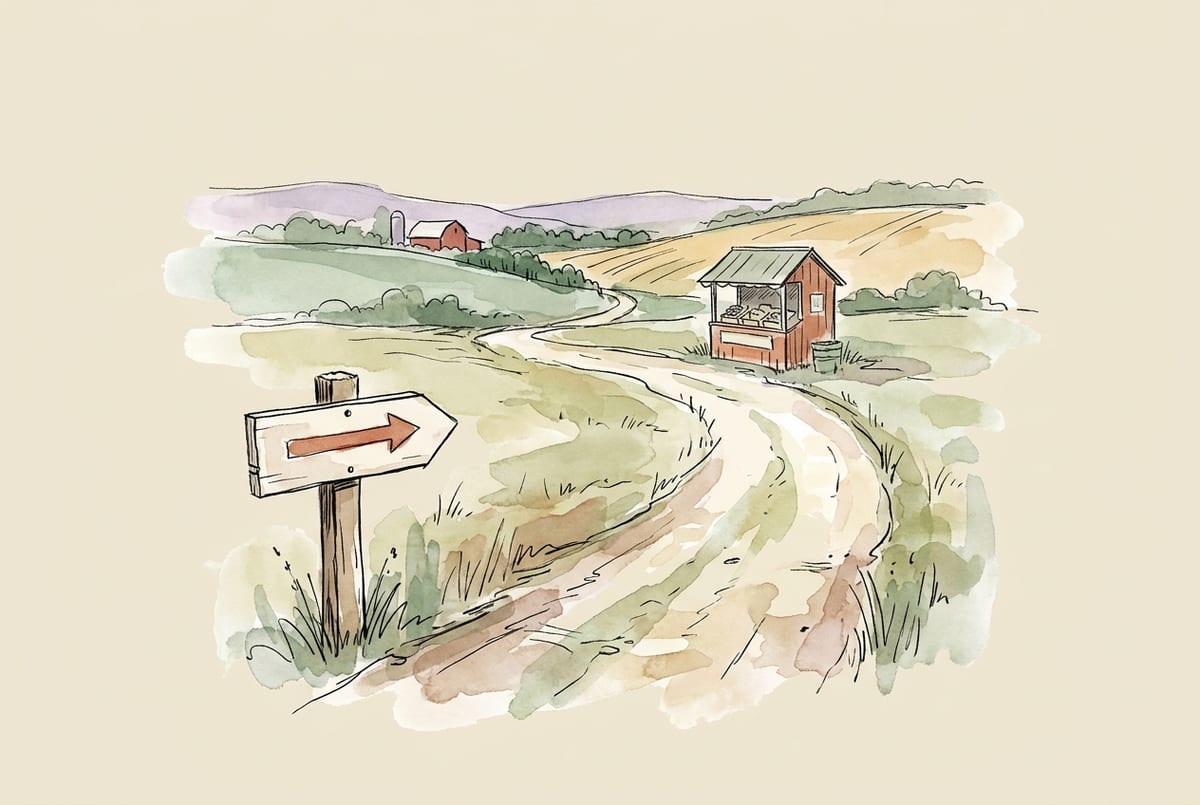
So use a simple two-sign system:
- The advance sign is short and directional. "Farm Stand Ahead" or "Fresh Eggs, 1/4 Mile" with an arrow. Its only job is to buy the driver time.
- The at-the-stand sign can carry more: what is in season, prices, how to pay, and your name.
If your road is faster or the turn is tricky, a third sign right at the driveway ("Turn Here") is worth it.
Start Traders Till for free.
Cost your products, print compliant labels, and track every sale. Free forever plan, no card required.
Make it survive the weather
A farm stand sign lives outdoors in sun, rain, and wind, so build it to last:
- Use corrugated plastic ("coroplast"). It is the standard cheap, waterproof, UV-resistant yard-sign material, and it is what our free templates are sized for. Print at a local sign shop or online. Most yard signs you order online come with a wire stake included, so you are ready to stake it the day it arrives.
- Making your own? Grab a stake. If you print the sign yourself, mount it on a wire H-stake: the metal prongs slide into the sign's flutes and push into the ground with no tools, and a pack of H-stakes runs only a few dollars. If you would rather stand your sign up than stake it into the ground, A-frame sign stands are available online too.
- Anchor it against wind. On an open road, zip-tie the sign to the stake at more than one point, or use a heavier U-frame stake so a gust does not fold it flat.
- Refresh it. Sun fades cheap ink in a season. A sign that has gone gray and curled says "nobody is minding this stand," which is the opposite of what you want.
Where you can (and cannot) put your sign
This is the part people skip, and it is the part that gets a sign taken down. The rules stack in three layers, and they genuinely differ from one place to the next:
- The public right-of-way. The strip of land along a road, including the shoulder and often a bit beyond, usually belongs to the state or town, and private signs staked in it can be removed by road crews without notice. That roadside spot that seems perfect may not be yours to use. Your state DOT district office can tell you where the right-of-way ends.
- Local sign ordinances. Cities and counties set their own rules on sign size, number, setback, and whether you need a permit, and those rules are often stricter in residential zones than in agricultural or commercial ones. Your local zoning or planning office is the place to ask.
- Your HOA, if you have one. Covenant rules can forbid a sign that the city would happily allow. Check the covenants before you stake anything.
None of this is meant to scare you off. Most on-premise farm signs on your own property are fine, and a friendly call to the zoning office usually takes ten minutes. The point is to ask first.
And a note on being a good neighbor, especially in or near a residential area: keep it tasteful and quiet. Skip anything that invites honking or noise. Nothing turns neighbors into complainers, and complaints into an ordinance problem, faster than a stand that makes the street louder. A sign that says "Stop for Fresh Eggs" does the job without ever asking anyone to lay on the horn.
Once they stop, keep it honest
Getting the car to pull in is the hard part. The rest is making the stop feel easy and safe, for them and for you.
A clear at-the-stand sign that lists prices and shows how to pay (cash box, and a QR code to Venmo or Square if you take cashless) removes the little frictions that make a first-time visitor leave without buying.
And since most stands run on the honor system, a quiet "smile, you're on camera" sign by the cash box keeps the occasional wobbler honest without making your good customers feel suspected. We have a whole free pack for that too, over in our guide on stopping farm stand theft. Together, the roadside signs get them in and the honor-system signs keep the box full.
A note from April: I first started using yard signs for advertising back when I was selling baby chicks in Littlerock, California. I staked one near a main road with an arrow pointing to my ranch, and it drove a surprising amount of weekend traffic. Those signs more than paid for themselves.
Ever since, I catch myself thinking up ways to use a good yard sign for just about any kind of outdoor advertising. When I order mine, my go-to is GotPrint.com (not an affiliate link, I just genuinely love them).
Measure whether it is working
Here is the habit almost nobody keeps: notice what your sign actually does to your sales. When you put out a new advance sign, or change the headline from "Produce" to "Sweet Corn," watch whether more cars stop that week.
You do not need a spreadsheet full of theory, just an honest record of sales day to day so you can see cause and effect. That is a big part of what we are building Traders Till to do: track every sale and cost so you can tell what a better sign, a new spot, or an in-season headline is really worth, instead of guessing.
Bottom line
Your sign is the first thing a customer meets and the reason most of them stop at all. Make it say what you sell and that you are open, in letters big enough to read from a moving car, with few enough words to take in at a glance. Put one sign up the road and one at the stand, build it to survive the weather, and make sure it is somewhere you are allowed to put it.
Do that, and a quiet roadside table starts catching the traffic that used to drive right past.
Start with the template that fits your stand, below.
You’re in! Check your inbox to confirm your subscription, and your free farm stand yard-sign templates are on their way.
Ten designs, sized for standard 24 x 18 in signs. We email you the pack. No spam, unsubscribe anytime. Entering your email also subscribes you to the Traders Till newsletter.
Sources
Every source below was checked against the issuing agency's own page on July 18, 2026.
-
Penn State Extension. Roadside Signage for Farm and Agritourism Operations. extension.psu.edu
-
Penn State Extension. Developing a Roadside Farm Market. extension.psu.edu
-
Ohio State University Extension (Ohioline ANR-70). Creating Signage for Direct Food and Agricultural Sales. ohioline.osu.edu
-
United States Sign Council. Sign Legibility Rules of Thumb.
-
Federal Highway Administration. Sign legibility and message design research (FHWA-HRT-15-027). fhwa.dot.gov
Summarize & Save This Guide On
Add Traders Till As A Preferred Source on Google Prompt copiedApril Lee has a B.S. in Agriculture from Cal Poly Pomona, is a certified food handler (ANAB-accredited, Learn2Serve), and holds ANAB-accredited food allergy training. She writes about selling homemade and homegrown products - cottage food rules, pricing, and the business side of farm stands - and is the co-founder of Traders Till, an app that helps home producers track what they make, sell, and earn.
Start Traders Till for free.
Cost your products, print compliant labels, and track every sale. Free forever plan, no card required.
 Save to Pinterest