

Cash accounting records money when it actually moves: you count income the day a customer pays you, and you count an expense the day you pay for it. Accrual accounting records money when it is earned or owed, even before the cash changes hands. Almost every cottage food seller should use the cash method. It is simpler, it matches your bank account, and it is what small businesses overwhelmingly pick.
This is general information, not tax or accounting advice. Accounting-method rules, especially the ones about inventory, get technical fast and depend on your specific numbers. For anything beyond the basics here, check IRS Publication 334 or talk to a tax pro.
What is the cash method?
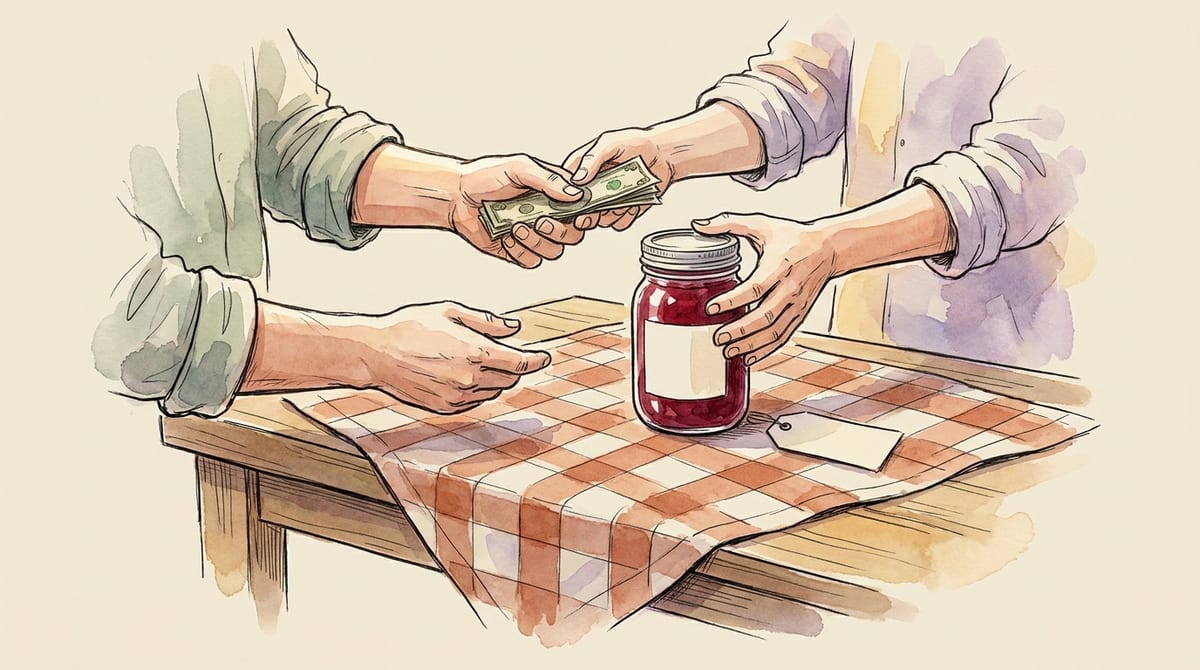
The cash method is exactly how you already think about money. You record income "when you actually or constructively receive it," and you deduct expenses "when you actually pay them," in the words of IRS Publication 334.
So if a customer buys $40 of jam at Saturday's market and hands you cash, that $40 is income on Saturday. If you buy $18 of sugar on Tuesday, that is an $18 expense on Tuesday. Nothing gets recorded until the money moves.
Why makers love it:
- It matches your bank account, so your books and your balance tell the same story.
- There is nothing to track but what actually happened: money in, money out.
- You are never taxed on income you have not been paid yet.
For a home food business with no employees and no invoicing, the cash method removes almost all of the guesswork. This is the foundation everything else in your bookkeeping basics sits on.
What is the accrual method?
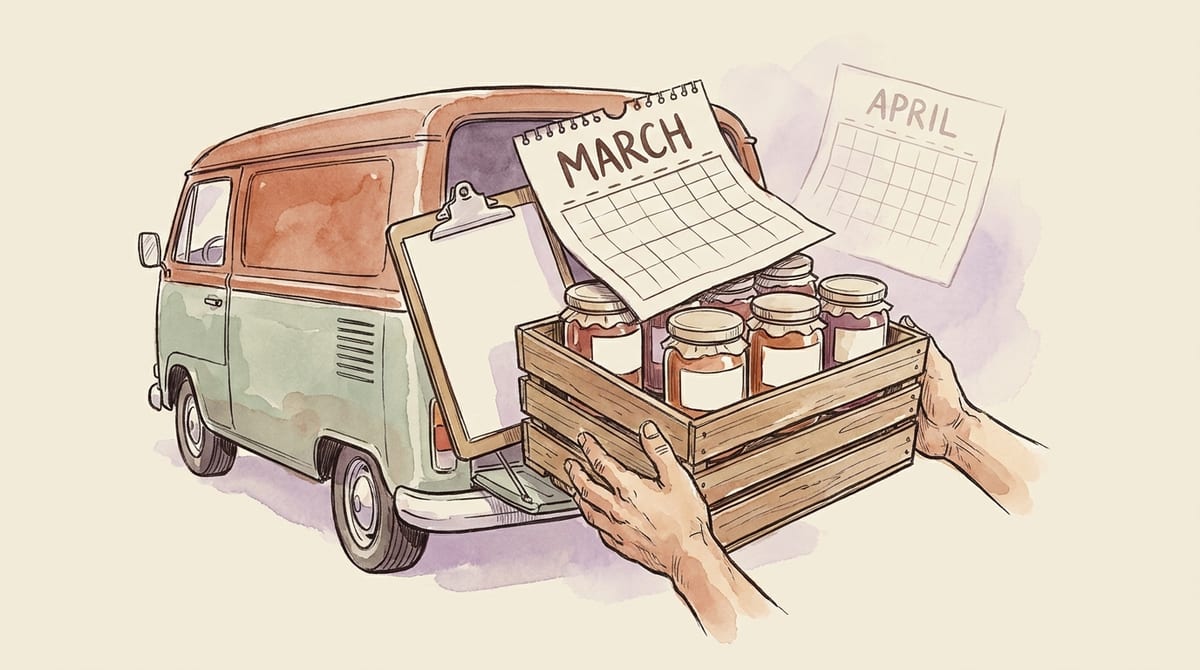
The accrual method records income "when you have a right to receive it" and expenses "when you incur the obligation to pay them," regardless of when cash actually moves (IRS Pub 334).
Picture a wholesale order. A cafe orders $300 of your granola in March, you deliver it in March, and they pay you in April. Under accrual, that $300 is March income, the month you earned it, not April when the check clears. Same idea on the expense side: if you order $200 of jars in March and pay the bill in April, accrual counts it as a March expense.
The point of accrual is matching. It lines up the revenue from a sale with the costs of making that sale in the same period, so a business with lots of credit, invoicing, or inventory sees a truer picture of profit. That precision comes at a cost: you are tracking money that has not moved yet, which means accounts receivable, accounts payable, and more moving parts than a one-person kitchen usually wants.
Which method should a small food business use?
For almost every cottage food seller: cash. It is simpler, it matches how the money really flows through your business, and it is the method small operations overwhelmingly use. Unless a tax pro tells you otherwise, cash is the right default.
A few signs you are firmly in cash-method territory:
- You are a sole proprietor filing a Schedule C.
- Customers pay you at the point of sale, in cash, card, or an instant app.
- You do not carry large amounts of inventory or bill clients on 30-day terms.
If your business grows into steady wholesale accounts, real invoicing, or serious inventory, that is the moment to sit down with an accountant and ask whether accrual would serve you better. Most home food businesses never reach that point.
Start Traders Till for free.
Cost your products, print compliant labels, and track every sale. Free forever plan, no card required.
Schedule C actually asks which method you use
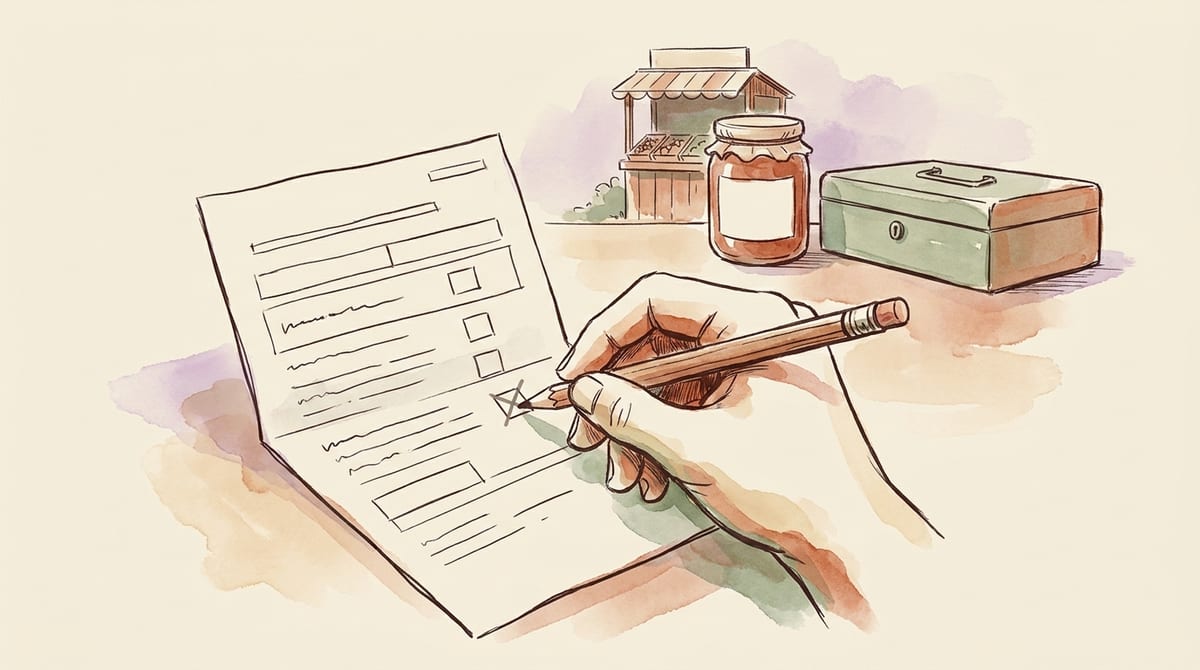
This is not just theory. When you file, Schedule C has a line in Part I (line F) that asks which accounting method you use: cash, accrual, or other. You check a box. For most makers that box is Cash, and that single check is the whole decision as far as the form is concerned.
You pick your method on the first tax return you file for the business, so it is worth being deliberate about it the first year rather than defaulting by accident.
But I have inventory. Doesn't that force accrual?
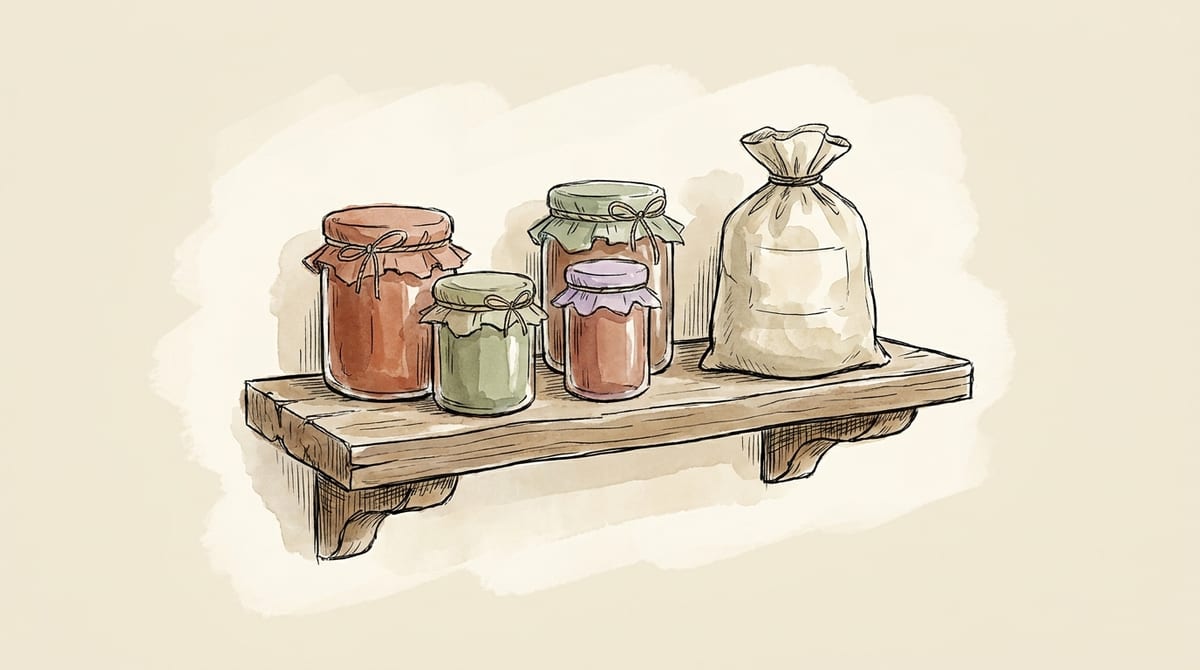
This is the part people get tangled in, so here is the honest version.
For a long time the rule of thumb was that a business carrying inventory had to use the accrual method, at least for the inventory piece. That pushed a lot of small makers toward more complex books than they needed.
That pressure has eased. Publication 334 includes an "Exception for small business taxpayers" that lets qualifying small businesses use the cash method and treat inventory in a simplified way, rather than being forced into full accrual inventory accounting (IRS Pub 334). The gross-receipts limit for that exception runs into the tens of millions of dollars a year, so a cottage food seller is nowhere near the ceiling. In plain terms: having some jars of jam or bags of flour on hand does not, by itself, force you onto the accrual method.
What it does mean is that you still have to account for that inventory sensibly, which is really a tracking your inventory and cost of goods sold question. How inventory flows into your taxable profit is its own topic, covered in inventory for taxes.
The inventory rules are where the simple story gets technical, and where the exact treatment depends on your numbers. If you carry meaningful inventory, confirm your approach against Publication 334 or with a tax pro before you file. That is the one nuance on this page worth a second opinion.
Can I change my method later?
You can, but it is not a free switch. Once you have chosen a method on your first return, changing to a different one generally requires the IRS's consent rather than just doing it on your own (IRS Pub 334, Change in Accounting Method). In practice that means filing a form to request the change (Form 3115) and following the IRS procedure, which is a good reason to loop in a tax pro if you reach that point.
For almost every reader, this is a non-issue. You pick cash at the start, it keeps fitting as you grow, and you never need to change anything.
Bottom line
Cash accounting counts money when it moves. Accrual counts it when it is earned or owed. For a home or cottage food business, cash is simpler, matches your bank account, and is almost always the right call. You confirm it with one checkbox on Schedule C, inventory usually does not force you off it, and switching later takes IRS permission, so choose deliberately the first year. The real work is not the method, it is keeping clean records underneath it.
Good recordkeeping and a couple of free accounting tools will do more for your taxes than agonizing over cash versus accrual ever will. For the full picture of how a home food business handles taxes, start with the home food business taxes guide.
Traders Till tracks your sales and expenses on the cash basis automatically, the way almost every maker files. Money in, money out, tagged and ready at tax time, with no spreadsheet to babysit. Start free
Sources
Every source below was checked against the issuing agency's own page on September 13, 2026.
Summarize & Save This Guide On
Add Traders Till As A Preferred Source on Google Prompt copiedApril Lee has a B.S. in Agriculture from Cal Poly Pomona, is a certified food handler (ANAB-accredited, Learn2Serve), and holds ANAB-accredited food allergy training. She writes about selling homemade and homegrown products - cottage food rules, pricing, and the business side of farm stands - and is the co-founder of Traders Till, an app that helps home producers track what they make, sell, and earn.
Start Traders Till for free.
Cost your products, print compliant labels, and track every sale. Free forever plan, no card required.
 Save to Pinterest