

Most home food sellers are not broke because they sell too little. They are broke because they priced wrong. The seven mistakes below all share one root: pricing on ingredients instead of on true cost. Skip your labor, your packaging, and your overhead, and a busy market day just loses money faster. Fix the math and the same table finally pays you.
A quick cost illustration (so the mistakes make sense)
Every mistake below points back to one honest number: your cost floor, the price under which every sale makes you poorer. Here is a batch of strawberry jam, 24 half-pint jars, costed the right way:
| Layer | Per jar |
|---|---|
| Ingredients (fruit, sugar, pectin) | $1.00 |
| Packaging (jar, lid, label) | $1.25 |
| Labor (3.5 hrs at $18, over 24 jars) | $2.63 |
| Overhead (booth, insurance, fuel) | $1.00 |
| True cost floor | $5.88 |
Ingredients are $1.00. The real cost is $5.88. That six-to-one gap is where every mistake on this list hides. The full walkthrough lives in the pillar: how to price homemade food.
Mistake 1: Not counting your labor
The trap: you add up ingredients, maybe packaging, and call that your cost. Your own hours count as zero.
Why it is costly: labor is usually the biggest line in a handmade product, not the smallest. In the jam batch, labor is $2.63 a jar, more than the fruit and the jar combined. Price without it and you have priced your groceries and donated your weekend.
Michigan State University Extension names this directly: crafters turning a hobby into a business "neglect to pay themselves a fair wage for their time or misjudge the amount of time it actually takes to create a piece, start to finish" (MSU Extension).
The fix: pick an honest hourly rate (most home food sellers start at $15 to $25) and count every hour, from shopping to cleanup to the drive to market. Then divide by yield. Details: paying yourself a real maker wage.
Mistake 2: Forgetting packaging and the hidden costs
The trap: you remember the flour and the fruit, then forget the jar, the label, the booth fee, the fuel, the card-reader cut, and the batch that failed to set.
Why it is costly: these add up to more than sellers expect. In the jam, packaging alone ($1.25) beats the ingredients ($1.00), and overhead adds another $1.00. That is $2.25 a jar that pure ingredient math ignores completely.
University of Maryland Extension is blunt about the scope: "be sure to calculate all the costs included not only in production, but also in marketing and distribution" (UMD Extension).
The fix: build the full cost stack once (ingredients plus packaging plus labor plus overhead), then reuse it. The method, including yields and waste, is here: how to calculate COGS for homemade food.
Mistake 3: Copying the grocery-store price instead of your cost
The trap: supermarket jam is $4, so you price yours at $5 to "stay competitive."
Why it is costly: the grocery store makes jam by the tanker load; you make 24 jars on a Saturday. Their $4 has nothing to do with your $5.88 floor. Match it and you lose money on every jar. Worse, a suspiciously cheap price often lowers trust at a market: shoppers read $4 handmade jam as amateur or about to disappear.
The fix: your cost sets your floor, and your local market sets your ceiling. Walk your own market, find the real range for small-batch jam (often $9 to $12), and price inside it with confidence. More on why cheap backfires: the underpricing trap for handmade sellers.
Mistake 4: Trusting the "3x ingredients" shortcut
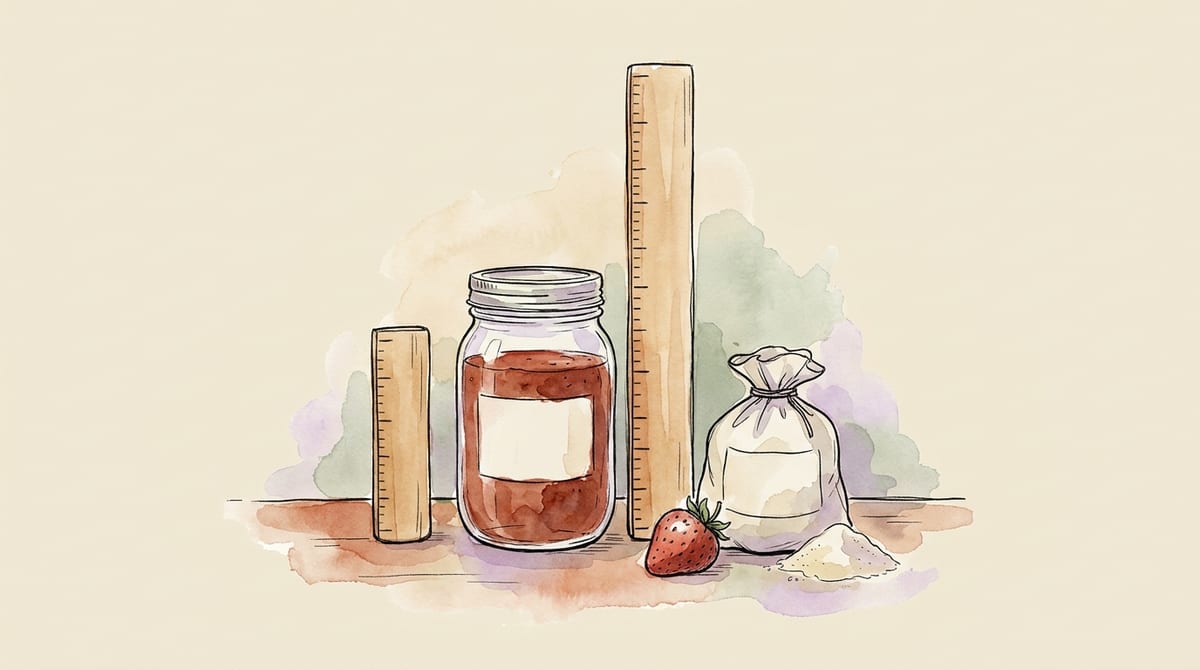
The trap: an old craft rule says multiply your materials by three and call it a price. For our jam, $1.00 of ingredients times three is $3.00.
Why it is costly: $3.00 is barely half the $5.88 it actually costs to make. Multiplier rules can work when materials are the dominant cost, but in handmade food, labor is. MSU Extension shows the "supplies times three" step as only one input in a larger formula, averaged against a labor-plus-overhead calculation, never the whole answer (MSU Extension). Any shortcut anchored to ingredients cannot see your time.
The fix: skip the shortcut and build the real stack. If you want a quick sanity check, flip it around: raw ingredients should land around a quarter to a third of your final price or less. In the jam, $1.00 of a $10 price is 10 percent, which is healthy. If ingredients are eating half your price, you are undercharging.
Start Traders Till for free.
Cost your products, print compliant labels, and track every sale. Free forever plan, no card required.
Mistake 5: Never raising prices as costs rise
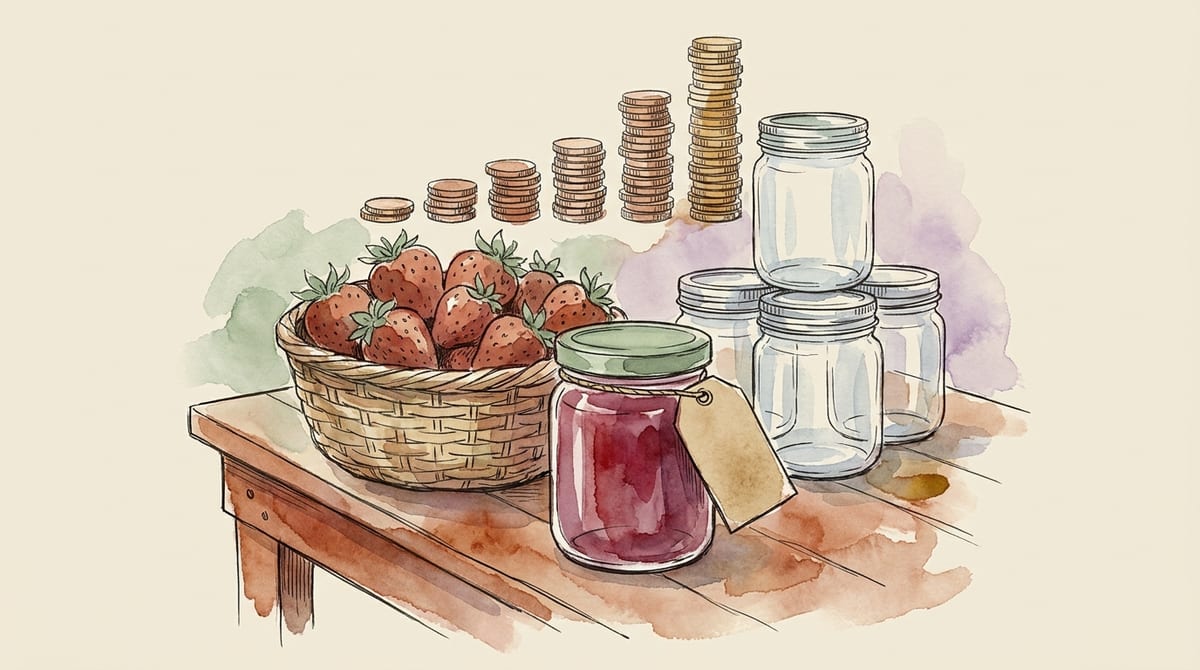
The trap: you set a price in year one and leave it there while berries, jars, and booth fees all creep up.
Why it is costly: ingredient creep never announces itself. If berries jump 20 percent, your $5.88 floor becomes about $6.30, and if the price stays put, that increase comes straight out of your margin. A year of quiet cost drift can erase your profit without a single slow sales day.
The fix: raise prices in whole dollars at natural moments (new season, new label, new flavor). Most market customers will not blink at a dollar, and "fruit costs went up this year" is all the explanation anyone needs.
This is also where per-batch tracking pays for itself: because Traders Till recalculates your true per-unit cost every time you log a batch, you catch the creep the week it happens instead of at tax time. Scripts and timing: how to raise prices without losing customers.
Mistake 6: Discounting to move product (and training buyers to wait)
The trap: sales feel slow, so you knock a dollar off, run a "market special," or mark down anything left at noon.
Why it is costly: two hits, not one. First, discounts come straight out of profit, the thinnest layer in your price. Drop a $10 jar to $8 and you did not lose 20 percent of the price, you lost nearly half your profit above the floor. Second, regular markdowns train your best customers to wait for the deal, so full-price sales dry up.
The fix: protect the floor and discount deliberately, not out of panic. Bundle instead of slashing ("$10 each, 3 for $27" still clears the floor with healthy margin), and let end-of-day markdowns be rare, not a schedule shoppers can predict. How to discount without eroding your price: a discount strategy that protects margin.
Mistake 7: Not tracking which products actually make money
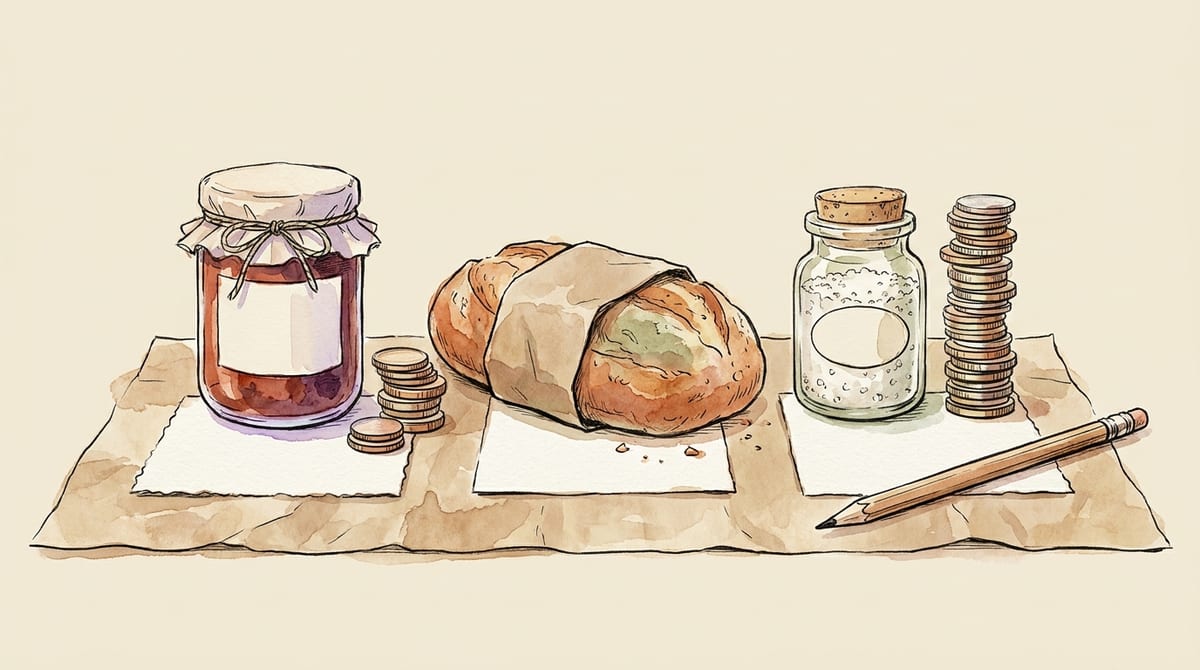
The trap: you look at total sales at the end of the day and assume the busy products are the profitable ones.
Why it is costly: revenue is not profit. A product that sells fast can still lose money if its floor is too high, while a slower product with a fat margin quietly carries the table. Without per-product numbers you cannot tell them apart, so you keep making the crowd-pleaser that pays you least.
Penn State Extension frames the whole discipline as cost-based pricing, where "your selling price is backed up by the actual costs of doing business," product by product (Penn State Extension).
The fix: track cost, price, and margin per product, then let the winners earn more of your time. See which homemade products are actually profitable, and for setting the target margins themselves, pricing for profit margins.
Bottom line
Every mistake on this list is the same mistake wearing a different hat: pricing on part of your cost instead of all of it. Count your labor, count your packaging and overhead, ignore the grocery shelf, skip the multiplier shortcuts, raise prices as costs rise, discount on purpose, and track profit per product. Do that and the jar that "felt fine" at $6 becomes a confident $10 that finally pays you.
The formula is not hard. The chore is that the inputs never sit still. Traders Till exists to make the math automatic: log a batch and it tracks your true per-unit cost, yield, and margin from your real numbers, so every price starts from what things cost this week.
Start free with Traders Till →
Want to price a product from scratch, start to finish? Start with the full guide: how to price homemade food.
Want pricing tips, seasonal cost alerts, and new guides in your inbox? Join the newsletter → (newsletter CTA, secondary)
Sources
Every source below was checked against the issuing agency's own page on July 10, 2026.
Summarize & Save This Guide On
Add Traders Till As A Preferred Source on Google Prompt copiedApril Lee has a B.S. in Agriculture from Cal Poly Pomona, is a certified food handler (ANAB-accredited, Learn2Serve), and holds ANAB-accredited food allergy training. She writes about selling homemade and homegrown products - cottage food rules, pricing, and the business side of farm stands - and is the co-founder of Traders Till, an app that helps home producers track what they make, sell, and earn.
Start Traders Till for free.
Cost your products, print compliant labels, and track every sale. Free forever plan, no card required.
 Save to Pinterest